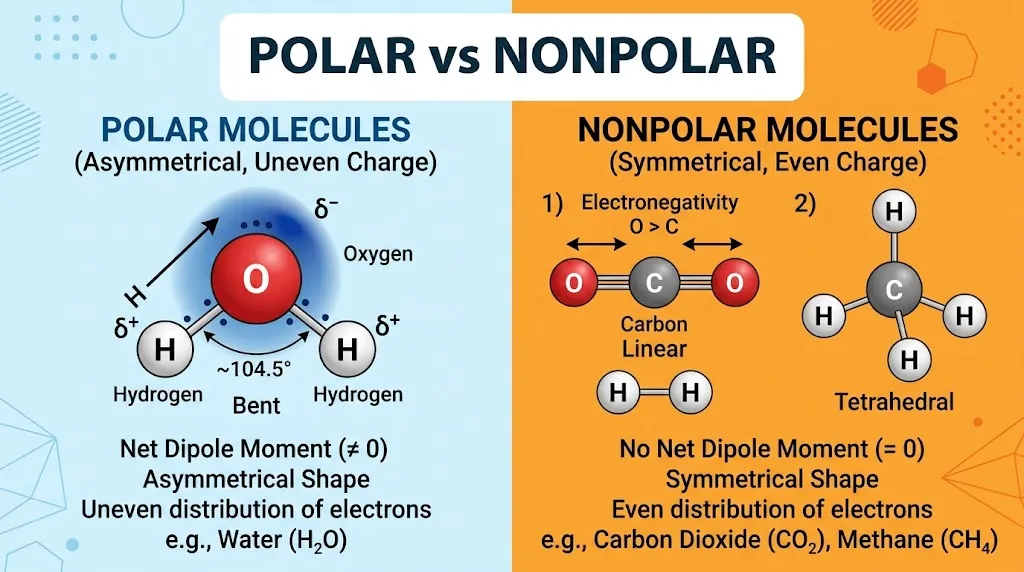
Polar vs nonpolar describes how electrical charge is distributed in a molecule. Polar molecules have an uneven charge distribution and a net dipole moment, while nonpolar molecules have no overall dipole. Molecular polarity depends on electronegativity, bond polarity, and especially the molecule’s three-dimensional shape.
Key Takeaways
- Polar molecules have an uneven distribution of electrical charge.
- Nonpolar molecules have no overall net dipole moment.
- A molecule can contain polar bonds and still be nonpolar.
- Molecular shape determines whether individual bond dipoles cancel.
- H₂O and NH₃ are common polar molecules, while CO₂, CH₄, and CCl₄ are common nonpolar examples.
What Does Polar Mean in Chemistry?
A polar molecule has an uneven distribution of electrical charge. One region of the molecule becomes slightly negative while another region becomes slightly positive. This happens when electrons are not shared equally and the molecular structure prevents the resulting bond dipoles from canceling.
The unequal sharing of electrons is closely related to electronegativity. Electronegativity describes how strongly an atom attracts shared electrons in a chemical bond.
For example, in water (H₂O), oxygen attracts the shared electrons more strongly than hydrogen. Water also has a bent molecular shape because of the lone pairs on oxygen. As a result, the two O–H bond dipoles do not cancel, giving water an overall dipole moment.
Polar Bonds
A polar bond forms when two bonded atoms have different abilities to attract electrons.
For example, an O–H bond is polar because oxygen and hydrogen have different electronegativities. However, having polar bonds does not automatically mean the entire molecule is polar.
That distinction is one of the most important ideas to understand when studying polar vs nonpolar molecules.
What Does Nonpolar Mean?
A nonpolar molecule has no overall separation of charge. Its net dipole moment is zero.
This can happen in two common ways. The molecule may contain bonds between atoms with similar electronegativities, or it may contain polar bonds arranged in a symmetrical way so their dipoles cancel each other.
Carbon dioxide (CO₂) is an excellent example. Each C=O bond is polar because oxygen attracts electrons more strongly than carbon. However, CO₂ has a linear shape, with the two bond dipoles pointing in opposite directions. They cancel, leaving the molecule nonpolar.
Polar vs Nonpolar: Key Differences
| Feature | Polar | Nonpolar |
| Charge distribution | Uneven | Even overall |
| Net dipole moment | Usually nonzero | Zero |
| Bond polarity | Usually contains polar bonds | May contain nonpolar bonds or symmetrical polar bonds |
| Molecular shape | Often asymmetric | Often symmetrical |
| Common examples | H₂O, NH₃, HCl | CO₂, CH₄, CCl₄ |
| Main determining factors | Electronegativity + geometry | Bond cancellation + symmetry |
The important point is that molecular geometry matters just as much as bond polarity when deciding whether a molecule is polar or nonpolar.
How to Tell if a Molecule Is Polar or Nonpolar
You can use a simple four-step process.
Step 1: Draw the Lewis Structure
Start by drawing the molecule’s Lewis structure. This shows which atoms are connected and where the lone pairs of electrons are located.
Lone pairs are important because they can change the molecule’s three-dimensional shape.
Step 2: Check Electronegativity
Look at the atoms involved in each bond.
If two identical atoms are bonded, such as O₂ or N₂, the electrons are shared equally, so the bond is nonpolar. If the atoms have different electronegativities, the bond may be polar.
Step 3: Determine Molecular Shape
Next, determine the molecule’s geometry using its Lewis structure and VSEPR principles.
Common shapes include:
- Linear
- Bent
- Trigonal planar
- Trigonal pyramidal
- Tetrahedral
The three-dimensional arrangement determines how the bond dipoles point through space.
Step 4: Check Whether the Dipoles Cancel
This is the final test.
If the bond dipoles cancel each other, the molecule is nonpolar.
If they do not cancel, the molecule has a net dipole and is polar. OpenStax describes molecular dipole moment as the result of adding the individual bond moments while considering the molecule’s three-dimensional structure.
Polar vs Nonpolar Examples
1. Water (H₂O) — Polar
Water is polar.
Oxygen is more electronegative than hydrogen, so each O–H bond is polar. More importantly, water has a bent shape because oxygen has lone pairs. The bond dipoles therefore do not cancel.
The result is a molecule with a net dipole moment.
2. Carbon Dioxide (CO₂) — Nonpolar
CO₂ is one of the most useful examples for understanding this topic.
Its C=O bonds are polar, but the molecule is linear. The two oxygen atoms are positioned symmetrically around the carbon, so the two bond dipoles point in opposite directions and cancel.
Therefore, CO₂ is nonpolar overall.
3. Ammonia (NH₃) — Polar
NH₃ is polar.
Nitrogen is more electronegative than hydrogen, making the N–H bonds polar. Nitrogen also has a lone pair, giving ammonia a trigonal pyramidal molecular shape.
Because the bond dipoles do not cancel, NH₃ has a net dipole moment.
4. Methane (CH₄) — Nonpolar
Methane has a tetrahedral shape with four hydrogen atoms surrounding carbon.
Although the C–H bonds can have a small degree of polarity, their symmetrical arrangement causes the bond dipoles to cancel overall. Therefore, CH₄ is considered nonpolar.
5. Carbon Tetrachloride (CCl₄) — Nonpolar
CCl₄ is another classic example.
Each C–Cl bond is polar, but the molecule has a symmetrical tetrahedral arrangement. The four bond dipoles cancel, so the molecule has no overall dipole moment.
6. Boron Trifluoride (BF₃) — Nonpolar
BF₃ has three polar B–F bonds arranged in a symmetrical trigonal planar structure.
Because the bond dipoles balance each other, BF₃ is nonpolar. This is another example showing why you cannot determine molecular polarity by looking at individual bonds alone.
Polar Bonds vs Polar Molecules: Why They Are Not the Same
This is where many chemistry students make mistakes.
A polar bond describes an individual bond. A polar molecule describes the charge distribution of the entire molecule.
Consider CO₂:
C=O bond → polar
C=O bond → polar
CO₂ molecule → nonpolar
Why? The molecule is linear, and the two bond dipoles cancel.
Now compare that with H₂O:
O–H bond → polar
O–H bond → polar
H₂O molecule → polar
Water is bent, so its bond dipoles do not cancel.
This is why the safest method is to consider both electronegativity and molecular geometry rather than looking at the bonds alone.
Why Molecular Polarity Matters
Polarity helps explain how molecules interact with one another.
Polar molecules can experience dipole-dipole attractions, while nonpolar molecules primarily rely on temporary induced attractions known as London dispersion forces. Molecules capable of hydrogen bonding can experience an especially important type of intermolecular attraction when hydrogen is bonded to highly electronegative atoms such as nitrogen, oxygen, or fluorine.
Polarity also helps explain differences in properties such as solubility and interactions between substances.
A familiar example is the separation of oil and water. Water is strongly polar, while many components of oil are largely nonpolar. Their different molecular interactions make them poorly miscible under ordinary conditions.
Common Mistakes When Identifying Polarity
Mistake 1: Assuming Every Molecule With Polar Bonds Is Polar
This is incorrect.
CO₂ and CCl₄ contain polar bonds but are nonpolar molecules because their molecular structures allow the dipoles to cancel.
Mistake 2: Ignoring Molecular Shape
You cannot always determine polarity from a chemical formula alone.
The three-dimensional arrangement of atoms is essential because dipole moments are vectors. Their direction matters.
Mistake 3: Confusing Symmetry With Identical Bonds Only
A molecule can contain several polar bonds and still be nonpolar if those bonds are arranged symmetrically.
BF₃ and CCl₄ demonstrate this clearly.
Mistake 4: Forgetting Lone Pairs
Lone pairs can change molecular geometry.
For example, the lone pairs on oxygen contribute to water’s bent structure. That bent shape prevents the O–H bond dipoles from canceling.
Frequently Asked Questions
Is H₂O polar or nonpolar?
H₂O is polar. Oxygen attracts electrons more strongly than hydrogen, making the O–H bonds polar. Because water has a bent shape caused by lone pairs on oxygen, the bond dipoles do not cancel. Water therefore has a net dipole moment.
Is CO₂ polar or nonpolar?
CO₂ is nonpolar overall. Its individual C=O bonds are polar, but the molecule is linear and symmetrical. The two bond dipoles point in opposite directions and cancel each other.
Is CH₄ polar or nonpolar?
CH₄ is nonpolar. Its tetrahedral structure distributes the four C–H bonds symmetrically, causing their dipole effects to cancel overall.
Is NH₃ polar or nonpolar?
NH₃ is polar. Its N–H bonds are polar, and the lone pair on nitrogen gives the molecule a trigonal pyramidal shape. The bond dipoles do not cancel, producing a net dipole.
Can a molecule have polar bonds but be nonpolar?
Yes. This is one of the most important concepts in molecular polarity. CO₂, CCl₄, and BF₃ all contain polar bonds, but their symmetrical molecular structures cause the bond dipoles to cancel.
What is the easiest way to identify a polar molecule?
First check whether the bonds are polar. Then determine the molecule’s three-dimensional shape. Finally, ask whether the bond dipoles cancel. If they cancel, the molecule is nonpolar; if they do not, the molecule is polar.
Final Takeaway
Understanding polar vs nonpolar becomes much easier when you separate two ideas: bond polarity and molecular polarity. Electronegativity tells you whether electrons are pulled unevenly within a bond, while molecular geometry tells you whether those individual pulls cancel.
Remember the simplest rule: polar bonds do not always create a polar molecule. Look at the complete three-dimensional structure. Water and ammonia are polar because their dipoles do not cancel, while CO₂, CH₄, CCl₄, and BF₃ are nonpolar because their charge effects cancel overall.