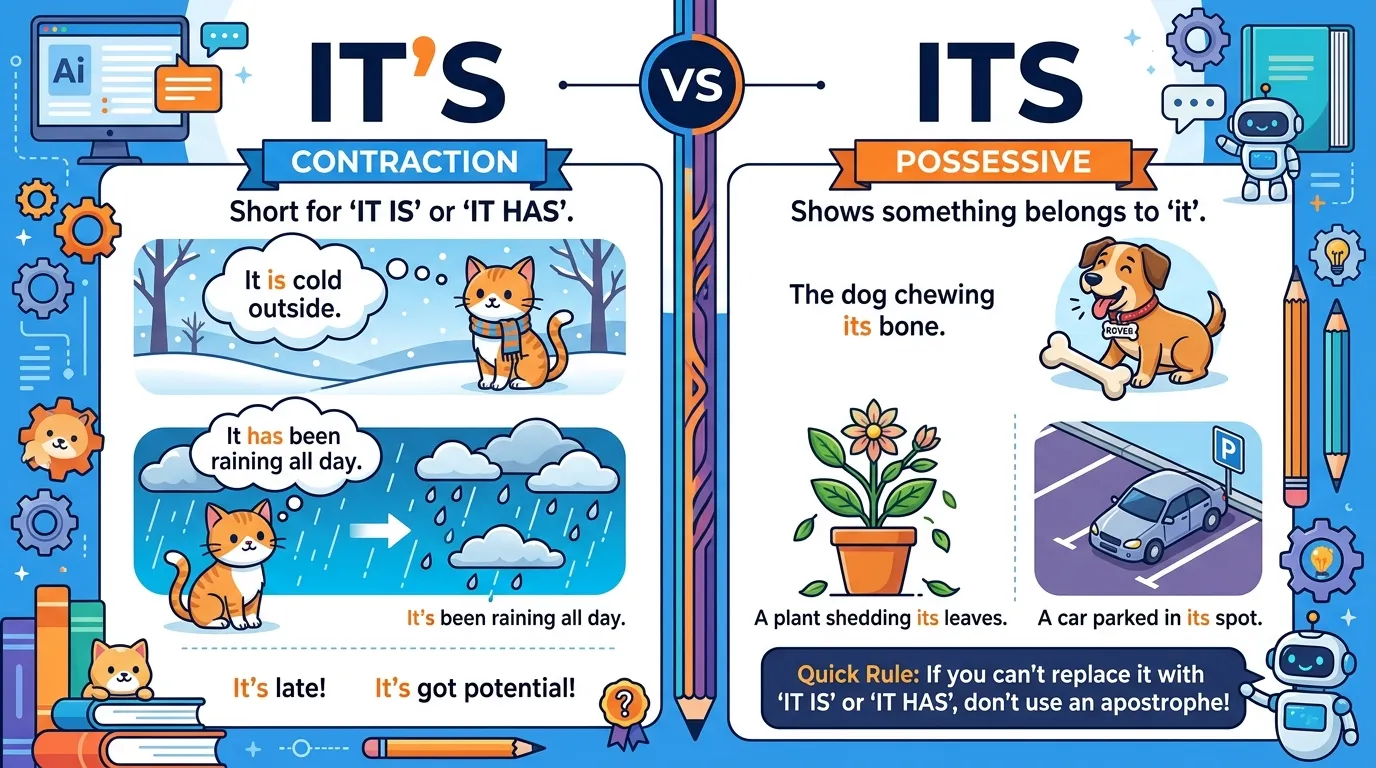
It’s is a contraction of “it is” or “it has.” Its is the possessive form of “it,” showing that something belongs to or is associated with something else. A simple test is to replace the word with “it is” or “it has.” If the sentence still makes sense, use it’s; otherwise, use its.
Key Takeaways
- It’s means “it is” or “it has.”
- Its shows possession or association.
- Its does not use an apostrophe.
- Try replacing it’s with “it is” or “it has” to check your sentence.
- Its’ is not the standard possessive form.
What Is the Difference Between It’s and Its?
If you have ever stopped while writing and wondered whether you should type it’s or its, you are not alone. These two words look almost identical and are pronounced the same, but they perform different grammatical jobs.
The main rule is simple:
It’s = it is / it has
Its = belonging to it
For example:
- It’s cold outside. → It is cold outside.
- The dog wagged its tail. → The tail belongs to the dog.
The apostrophe is the key visual difference, but it does not indicate possession in it’s. Here, the apostrophe signals that letters have been omitted from it is or it has.
What Does “It’s” Mean?
It’s is a contraction. It combines two words into one shorter form.
There are two meanings of it’s:
- It is
- It has
It’s = It Is
Use it’s when you could write it is instead.
Examples:
- It’s raining outside.
- It’s too late to leave.
- It’s a beautiful day.
- It’s difficult to explain.
- It’s my favorite restaurant.
- It’s getting colder.
Try expanding the first example:
It’s raining outside.
becomes:
It is raining outside.
The sentence still works, so it’s is correct.
It’s = It Has
It’s can also be short for it has, especially when has is helping form a verb phrase.
Examples:
- It’s been a long day.
- It’s already started.
- It’s become a serious problem.
- It’s never happened before.
- It’s changed a lot over the years.
For example:
It’s been a busy week.
means:
It has been a busy week.
This is an important part of the rule because some people remember only “it’s = it is” and forget that it can also mean “it has.”
What Does “Its” Mean?
Its without an apostrophe is the possessive form of it. It shows that something belongs to, comes from, or is associated with something previously mentioned.
Examples:
- The dog chased its ball.
- The company changed its logo.
- The phone lost its signal.
- The tree dropped its leaves.
- The car needs its tires replaced.
- The school updated its website.
In the sentence:
The dog wagged its tail.
Its tells us that the tail belongs to the dog.
The same idea appears with objects, organizations, animals, places, and other things:
The computer lost its connection.
The connection is associated with the computer.
It’s vs Its: Side-by-Side Comparison
| Word | Meaning | Function | Example |
| It’s | It is | Contraction | It’s cold today. |
| It’s | It has | Contraction | It’s been a long day. |
| Its | Belonging to it | Possessive form | The cat cleaned its paws. |
The easiest distinction is this:
If you mean “it is” or “it has,” use it’s.
If you mean “belonging to it,” use its.
This rule is consistent with major English-learning and grammar references.
The Easy “It Is” or “It Has” Test
Here is one of the quickest ways to solve an it’s vs its question.
Step 1: Look at the sentence.
For example:
The restaurant changed its menu.
Step 2: Replace “its” with “it is” or “it has.”
You would get:
The restaurant changed it is menu.
That does not make sense.
So its is correct.
Now try:
It’s getting late.
Replace it’s with it is:
It is getting late.
That works perfectly.
Therefore, it’s is correct.
You can also test sentences involving it has:
It’s been three hours.
→ It has been three hours.
That works, so it’s is correct.
This replacement method is one of the most practical ways to catch the mistake while proofreading.
It’s vs Its Examples
Examples With It’s
Here are several everyday examples:
- It’s time to go home.
- It’s really hot today.
- It’s not my responsibility.
- It’s hard to believe.
- It’s almost midnight.
- It’s been a great experience.
- It’s already finished.
- It’s getting better.
In each sentence, it’s can be expanded to it is or it has.
Examples With Its
Now look at examples showing possession:
- The cat licked its paw.
- The company announced its new policy.
- The phone needs its charger.
- The bird returned to its nest.
- The house lost its roof during the storm.
- The website changed its design.
- The car has its own parking space.
- Every business has its own challenges.
In these sentences, its connects something with the thing it belongs to or is associated with.
Incorrect vs. Correct Examples
| Incorrect | Correct | Why? |
| The dog hurt it’s leg. | The dog hurt its leg. | The leg belongs to the dog. |
| Its raining today. | It’s raining today. | It’s = it is. |
| The company changed it’s name. | The company changed its name. | The name belongs to the company. |
| Its been a long day. | It’s been a long day. | It’s = it has. |
| The machine lost it’s power. | The machine lost its power. | The power is associated with the machine. |
Why Is It’s vs Its So Confusing?
The confusion usually comes from the apostrophe.
In many English nouns, an apostrophe can show possession:
- Sarah’s phone
- The dog’s bowl
- The teacher’s desk
- The company’s website
So it is understandable that someone might assume it’s means something belongs to “it.”
But it’s has a different job. It is a contraction of it is or it has.
Meanwhile, its is the possessive form.
This makes its unusual because it does not need an apostrophe even though it expresses possession. Possessive pronouns such as his, hers, ours, yours, theirs, and its do not use apostrophes.
What About “Its’”?
You may sometimes see its’, but it is not the standard form you should use in modern English.
For ordinary writing, choose between:
- it’s
- its
Never add an apostrophe after the s to create a possessive form.
For example:
Correct: The company updated its website.
Incorrect: The company updated its’ website.
If you are showing possession, use its.
How to Remember It’s vs Its
A simple memory trick can make this rule much easier.
Remember: Apostrophe = Missing Letters
Think of the apostrophe in it’s as a signal that something has been shortened.
it is → it’s
it has → it’s
So:
It’s cold.
= It is cold.
It’s been fun.
= It has been fun.
For its, think of words such as his and her.
- his car
- her car
- its car
None of these possessive forms needs an apostrophe.
One-Second Rule
Ask:
Can I replace it with “it is” or “it has”?
- Yes → it’s
- No → its
For example:
The dog loves it’s owner.
Try the test:
The dog loves it is owner.
That sounds wrong.
So:
The dog loves its owner.
Now:
It’s a great idea.
→ It is a great idea.
That works, so it’s is correct.
Common Questions About It’s vs Its
Is its possessive?
Yes. Its is the possessive form of it and shows that something belongs to or is associated with something. For example, “The company updated its website” means the website belongs to or is associated with the company. Unlike many possessive nouns, its does not use an apostrophe.
Is it’s always a contraction?
Yes. In standard English, it’s is a contraction of either it is or it has. For example, “It’s cold” means “It is cold,” while “It’s been difficult” means “It has been difficult.”
Can it’s mean “it has”?
Yes. This is an important use of it’s. For example, “It’s been a long week” means “It has been a long week.” If replacing it’s with it has produces a grammatically correct sentence, the apostrophe form is appropriate.
Which is correct: its or it’s?
Both are correct words, but they are used in different situations. Use it’s for it is or it has. Use its when showing possession or association. The correct choice depends on what the sentence means.
Does its ever need an apostrophe?
In standard modern English, the possessive form its is written without an apostrophe. It’s has an apostrophe because it is a contraction. Therefore, for normal contemporary writing, use its, not its’, when showing possession.
Conclusion
The difference between it’s vs its is much easier once you focus on what each word does.
It’s means “it is” or “it has.”
Its shows possession or association.
When you are unsure, use the replacement test. Try changing it’s to “it is” or “it has.” If the sentence still makes sense, keep it’s. If the sentence describes something belonging to or associated with “it,” use its.
Remember this simple rule:
It’s = it is / it has
Its = belonging to it
Once this distinction becomes familiar, one of the most common English apostrophe mistakes becomes much easier to avoid.