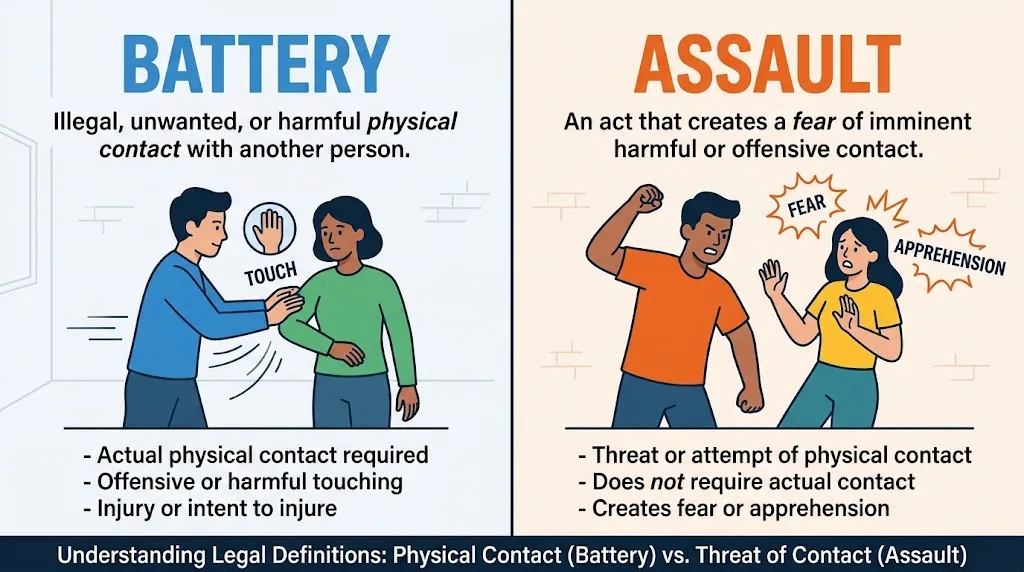
Battery vs assault usually comes down to the difference between physical contact and the threat or apprehension of imminent contact. Traditionally, assault involves intentionally causing someone to reasonably anticipate harmful or offensive contact, while battery involves the actual harmful or offensive physical contact. However, U.S. states do not all use these terms in the same way, so the exact legal definition depends on the jurisdiction.
Key Takeaways
- Assault traditionally focuses on the threat or apprehension of imminent harmful contact.
- Battery traditionally involves actual harmful or offensive physical contact.
- An assault can occur without anyone being touched.
- A battery can sometimes happen without a preceding assault, such as an unexpected attack.
- U.S. states differ significantly in how they define and charge assault and battery.
What Is Assault?
In traditional U.S. legal terminology, assault generally refers to an intentional act that causes another person to reasonably anticipate imminent harmful or offensive physical contact. The important point is that the person does not necessarily have to be touched.
For example, imagine someone raises a fist and moves toward another person as if they are about to punch them. If the circumstances cause the other person to reasonably anticipate an immediate harmful contact, that conduct may fit the traditional concept of assault.
The exact elements depend on the jurisdiction. Cornell’s Legal Information Institute explains that traditional assault involves an act, an intent to cause apprehension of imminent harmful or offensive contact, and circumstances that cause the victim to reasonably apprehend that contact.
Does Assault Require Physical Contact?
Not necessarily. Under the traditional distinction, physical contact is not required for assault.
That is one of the easiest ways to remember the difference:
Assault = anticipated harmful or offensive contact.
Battery = actual harmful or offensive contact.
However, this traditional explanation should not be treated as a universal definition of every U.S. criminal statute. Some states use the word assault for conduct that includes actual physical injury or contact.
What Is Battery?
Battery traditionally refers to intentional and unlawful harmful or offensive physical contact with another person.
The contact does not necessarily have to cause a serious injury. Depending on the applicable law, unwanted or offensive physical contact can be enough.
For example, intentionally striking someone, pushing them, or making another unauthorized physical contact could potentially constitute battery under a jurisdiction that recognizes battery as a separate offense.
Cornell’s Legal Information Institute notes that some jurisdictions maintain battery as a distinct crime involving unlawful force, bodily injury, or offensive contact.
Does Battery Require Physical Contact?
Under the traditional distinction, yes. Battery centers on the actual physical contact.
That contact can be different from what people imagine when they hear the word “attack.” A battery does not necessarily mean someone suffered a major injury. The legal issue may instead concern whether unlawful harmful or offensive contact occurred.
This is why the common shortcut is:
Assault involves the threat or apprehension; battery involves the contact.
But again, state statutes can use different terminology.
Battery vs Assault: Key Differences
The clearest traditional distinction looks like this:
| Feature | Assault | Battery |
| Traditional focus | Threat or apprehension of imminent contact | Actual physical contact |
| Physical contact required? | Usually no | Traditionally yes |
| Injury required? | No | Not necessarily |
| Can occur without the other? | Yes | Yes |
| State definitions identical nationwide? | No | No |
| Can be criminal or civil? | Yes, depending on jurisdiction and claim | Yes, depending on jurisdiction and claim |
The biggest mistake is assuming that these definitions apply word-for-word in every state. U.S. jurisdictions have developed different statutes and terminology. Some states distinguish assault and battery, while others combine or redefine them.
Can Assault Happen Without Battery?
Yes.
Under the traditional legal distinction, assault can occur without battery because actual physical contact is not necessary.
Consider this example:
Someone moves toward another person with a raised fist and appears ready to strike. The other person reasonably believes a punch is about to happen, but the first person stops before making contact.
There may be an assault under a traditional definition, but there was no battery because the anticipated physical contact never occurred.
The precise result, however, depends on the applicable state’s law and the facts of the incident.
Can Battery Happen Without Assault?
Yes.
A battery can occur without a separate assault when the physical contact happens without the victim having a reasonable opportunity to anticipate it.
For example, suppose someone unexpectedly strikes another person from behind. There may be actual unlawful physical contact, but there was no preceding moment in which the victim reasonably anticipated that specific contact.
This illustrates why assault and battery are related concepts rather than two mandatory steps in every case.
Can Someone Be Charged With Both?
Potentially, yes.
In jurisdictions that treat assault and battery as separate offenses, a single incident can involve both. For example, a person might threaten to strike someone, causing reasonable apprehension, and then follow through with unwanted physical contact.
Historically, this is part of the reason the phrase “assault and battery” became common.
However, the terminology varies considerably among U.S. jurisdictions. Some states have separate offenses, while others use assault as a broader term that can include conduct traditionally described as battery.
Why State Law Matters in the United States
This is perhaps the most important point for anyone researching battery vs assault.
There is no single nationwide criminal definition that controls every state.
For example, Cornell’s Legal Information Institute notes that criminal assault can refer to apprehension of harmful contact in some contexts, while in other jurisdictions the word assault can refer to the harmful contact itself.
Justia similarly explains that some states maintain the traditional distinction, while other states have expanded their definitions of assault to cover conduct historically described as battery. Texas, for example, defines assault in part to include certain physical contact that the defendant knows or should know would be considered offensive or provocative.
Illinois provides another example. Illinois Legal Aid Online explains that Illinois defines assault in terms of conduct placing another person in reasonable apprehension of receiving a battery, while battery concerns physical contact or bodily harm under the state’s law.
So if you are researching an actual case, the state statute and the specific charge are more important than relying on a general dictionary definition.
Criminal Assault and Battery vs. Civil Claims
The terms can also appear in two different legal settings: criminal law and civil law.
A criminal case involves the government prosecuting an alleged offense. A civil claim generally involves one person seeking a legal remedy, such as damages, from another.
Cornell’s Legal Information Institute explains that assault and battery can exist as both criminal concepts and civil torts, with the required elements differing depending on the type of claim and jurisdiction.
That means reading an article about “battery” does not automatically tell you what must be proven in a particular criminal prosecution or civil lawsuit.
Common Examples of Assault vs Battery
Example 1: Threatening to Punch Someone
A person moves toward someone with a raised fist and intentionally causes the other person to reasonably believe they are about to be punched.
Traditional concept: This may constitute assault even if no punch occurs.
Example 2: Unexpected Physical Contact
A person suddenly hits someone without warning.
Traditional concept: The physical contact may constitute battery, even though there was no preceding assault that the victim had an opportunity to perceive.
Example 3: Threat Followed by Physical Contact
A person threatens to punch someone, moves forward as if to do it, and then actually punches them.
Traditional concept: The incident may involve both assault and battery where the jurisdiction recognizes them as separate offenses.
The legal outcome depends on the facts and applicable law.
FAQs:
Is assault worse than battery?
There is no universal answer because the legal definitions, classifications, and potential penalties vary by jurisdiction and by the circumstances of the alleged offense. Some jurisdictions use different degrees of assault or battery, while others combine or redefine the offenses. It is better to examine the specific statute and charge rather than assume one term is always more serious.
Is battery always physical?
Traditional battery requires harmful or offensive physical contact. However, what legally qualifies as battery and whether the offense is called “battery” can vary by state. Some jurisdictions use broader assault statutes instead of maintaining battery as a separate criminal offense.
Can words alone be assault?
Words alone do not automatically constitute assault under the traditional definition. The circumstances generally matter, including whether the conduct causes a reasonable apprehension of imminent harmful or offensive contact. State law can differ, so a verbal threat should be evaluated under the statute that applies to the situation.
Are assault and battery separate crimes everywhere in the U.S.?
No. U.S. jurisdictions use different approaches. Some maintain separate assault and battery offenses, while others combine or redefine them under broader assault statutes. This is why a general explanation of the traditional distinction should not be treated as a substitute for the law of a particular state.
What should you check if you are facing a charge?
Start with the exact name and statute number of the charge, the state where the alleged incident occurred, and whether the matter is criminal or civil. The wording of the applicable statute determines the elements that must be established. For a real case, a licensed attorney in the relevant jurisdiction can explain how those rules apply to the facts.
Conclusion
The traditional distinction in battery vs assault is simple: assault generally concerns causing someone to reasonably anticipate imminent harmful or offensive contact, while battery concerns the actual physical contact.
But U.S. law is more complicated than that simple definition. States do not all use these terms in the same way, and some statutes use assault to cover conduct that traditional common law would call battery.
If you are studying the terminology, remember threat or apprehension versus actual contact. If you are dealing with an actual legal matter, check the law of the state involved and the precise charge rather than relying only on the traditional definitions.