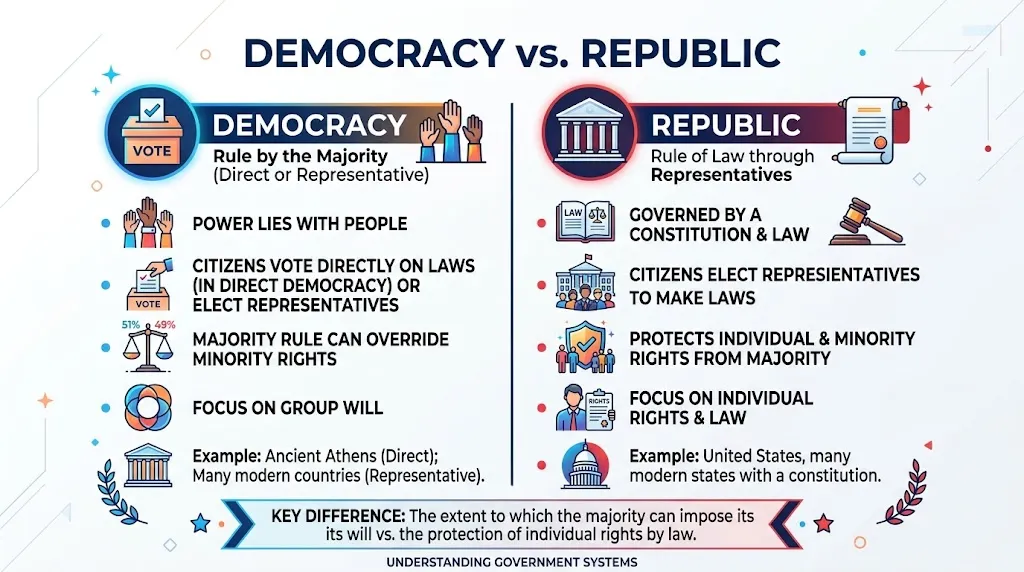
Democracy vs republic is not really an either-or question. A democracy is a system in which political authority comes from the people, while a republic generally uses elected representatives and a legal framework to govern. The United States is both: it is a constitutional republic that operates through representative democratic processes.
Key Takeaways
- A democracy focuses on political power coming from the people.
- A republic emphasizes representative government and a public system of laws rather than hereditary rule.
- Direct democracy allows citizens to vote directly on government decisions.
- Representative democracy allows citizens to elect officials who make decisions for them.
- The United States combines democratic participation with a constitutional republican structure.
What Is a Democracy?
A democracy is a form of government in which political authority ultimately comes from the people. Citizens can participate directly in government or choose representatives to act on their behalf.
The word is often associated with the idea of rule by the people. In practice, however, democracies can take different forms.
Direct Democracy
In a direct democracy, citizens participate directly in making specific government decisions.
For example, voters may directly approve or reject a proposed law through a ballot measure. Some U.S. states and local governments use initiatives and referendums for certain decisions.
Direct democracy is different from the federal structure of the United States, where citizens generally elect representatives to make laws.
Representative Democracy
In a representative democracy, people elect officials who make government decisions on their behalf.
This is an important part of how the United States operates. The U.S. Constitution establishes a Congress made up of the House of Representatives and Senate, while elections allow citizens to choose many of the officials who exercise governmental authority.
So, when someone says America is a democracy, they usually mean representative democracy, not a system in which every citizen votes directly on every federal law.
What Is a Republic?
A republic is a system of government in which public authority is exercised through institutions rather than through a hereditary monarch.
In the American constitutional context, republican government is closely associated with representation, popular sovereignty, elected officials, and government under law.
The Constitution explicitly says that the United States shall guarantee every state a “Republican Form of Government.”
A republic therefore does not simply mean “a country where people vote.” The term describes a broader governmental structure.
Core Features of a Republic
A modern constitutional republic may include:
- Elected or publicly accountable officials
- A written constitution or legal framework
- Limits on government power
- Rule of law
- Institutions that divide governmental authority
- Protection for individual rights
- Representation of citizens through government institutions
The U.S. Constitution divides federal power among legislative, executive, and judicial branches. This separation of powers is designed to prevent too much governmental authority from being concentrated in one person or institution.
Democracy vs Republic: Key Differences
The easiest way to understand democracy vs republic is to look at what each term emphasizes.
| Feature | Democracy | Republic |
| Main emphasis | Rule or participation by the people | Representative government and public law |
| Citizen role | Directly or indirectly participates | Usually chooses representatives |
| Direct voting | May be central in a direct democracy | Not required for every government decision |
| Representation | Common in modern democracies | A central feature of representative republics |
| Rule of law | Can be part of a democracy | Strongly associated with republican government |
| Hereditary ruler | Not required | A republic generally rejects hereditary monarchy |
| U.S. example | Elections and public participation | Constitution, elected institutions, and limited government |
These categories overlap. A country does not necessarily have to choose between being a democracy and being a republic.
That is the key point many simplified explanations miss.
Is the United States a Democracy or a Republic?
The United States can accurately be described using both terms, because they highlight different parts of the American political system.
The Constitution creates a representative governmental structure. Congress consists of the House of Representatives and Senate, and the Constitution establishes separate legislative, executive, and judicial branches.
At the same time, democratic principles are built into the system. The Constitution begins with “We the People,” and citizens participate in government through elections and other forms of civic participation. The U.S. Senate describes the country as having a representative form of government in which the people exercise political authority through elected representatives.
So a useful description is:
The United States is a constitutional republic that operates through representative democracy.
These terms are describing different characteristics of the same governmental system rather than two mutually exclusive systems.
What Did the Founders Mean by Democracy and Republic?
Some of the confusion comes from the way political terms were used during the founding period.
James Madison made an important distinction in Federalist No. 10. He described a “pure democracy” as a system in which citizens directly assembled and administered government. He contrasted that with a republic, in which representation plays a central role.
Madison’s distinction was therefore narrower than the way Americans commonly use the word democracy today.
The distinction also involved the size of the political community. Madison argued that a republic could operate across a larger territory because citizens did not need to gather together personally to make every government decision. Representatives could perform that function instead.
The historical record is more complicated than a simple “republic versus democracy” slogan. The Constitution Annotated notes that Founding-era discussions of republican government included concepts such as popular sovereignty and government derived from the people.
Are Democracy and Republic Opposites?
No. Democracy and republic are not necessarily opposites.
Think of the terms as answering somewhat different questions.
Democracy asks: Where does political authority come from?
Republic asks: How is that authority organized and exercised through public institutions and law?
There can be substantial overlap between the two.
For example, citizens in a representative democracy elect officials. Those elected officials may operate within a constitutional republic where government powers are divided and legally limited.
That is broadly what happens in the United States.
This is why saying “America is a republic, not a democracy” can create confusion. It treats two overlapping concepts as if they were mutually exclusive. Historical scholarship also cautions against treating the labels as perfectly separate categories.
Democracy vs Republic Examples
Imagine a city where residents vote directly on whether to approve a particular local proposal.
That is an example of direct democratic participation.
Now imagine residents elect a city council. The council studies proposals, debates them, and passes local laws on behalf of the residents.
That is representative government.
The United States uses representative institutions at the federal level. Citizens do not vote directly on every federal statute. Instead, they elect representatives who participate in the lawmaking process.
The Constitution also places limits on government authority and divides federal power among different branches.
This combination helps explain why the United States can be described as both democratic and republican.
Frequently Asked Questions
Is a republic a type of democracy?
A republic and a democracy are not identical concepts, but they can exist together. Many modern republics use democratic elections and representative institutions. In the United States, republican constitutional structures operate alongside representative democratic participation.
Why is America called a republic?
The U.S. is called a republic because its government is organized around public institutions, representation, constitutional law, and elected or publicly accountable officials rather than hereditary monarchy. The Constitution also explicitly requires the states to have a “Republican Form of Government.”
Can a country be both a democracy and a republic?
Yes. The terms describe different aspects of government and can overlap. The United States is commonly described as both a constitutional republic and a representative democracy.
Does the U.S. Constitution say America is a republic?
The Constitution does not use the exact phrase “United States is a republic,” but Article IV, Section 4 requires the federal government to guarantee every state a “Republican Form of Government.” The Constitution also establishes representative institutions and a system of divided governmental powers.
What is the main difference between democracy and republic?
The simplest distinction is that democracy emphasizes rule by the people, while republic emphasizes representative government and public institutions operating under law. In the United States, both ideas are part of the political system.
Conclusion
The debate over democracy vs republic often sounds like Americans must choose one label. The historical and constitutional picture is more nuanced.
A democracy emphasizes the role of the people in political authority. A republic emphasizes representative institutions and government under public law. The United States combines these features through elections, representative government, constitutional limits, separated powers, and federal institutions.
So, when you hear someone ask whether America is a democracy or a republic, the most informative answer is that the United States is a constitutional republic with a representative democratic system. Understanding both terms makes it easier to understand how American government actually works.