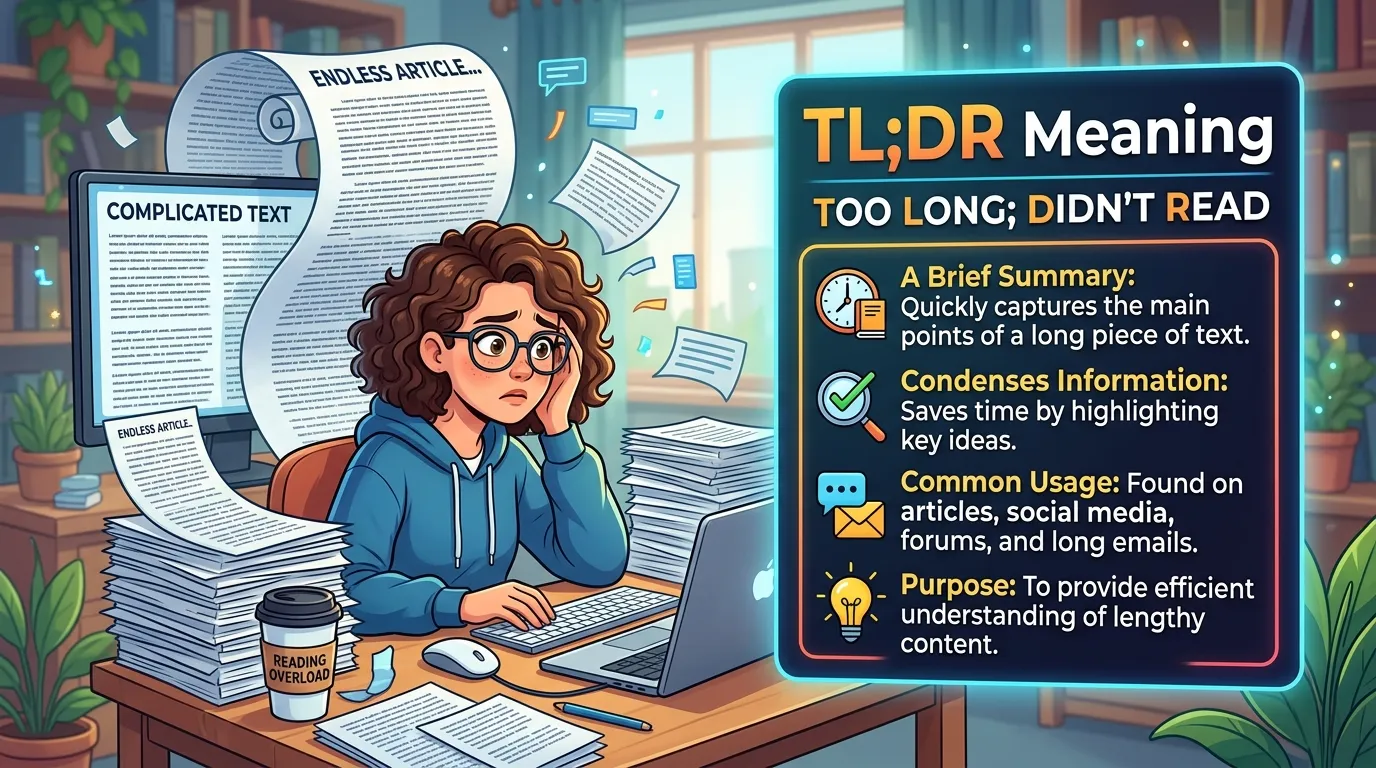
Have you ever opened a long message and thought, “I just need the main point”? I remember seeing TLDR for the first time at the end of a huge online post. I had no idea whether it was another internet abbreviation or something I was supposed to understand. Then I learned that it was actually pretty simple.
TLDR is one of the most common abbreviations used online when someone wants to give the short version of a long explanation. You’ll see it in texts, social media posts, comments, forums, emails, and gaming chats. If you’ve recently seen TLDR and wondered what it means, here’s everything you need to know.
Quick Answer: TLDR means “Too Long; Didn’t Read.” It’s a casual, internet-friendly way of saying that a message or post is very long and giving or asking for a short summary.
What Does TLDR Mean in Text?
TLDR stands for “Too Long; Didn’t Read.” It is an internet abbreviation used when someone wants to summarize a long piece of information or point out that they did not read the entire thing because it was too lengthy.
For example:
TLDR: The event starts at 7 PM, so arrive by 6:30.
Here, TLDR introduces the most important information without requiring the reader to go through a long explanation.
Sometimes people also use TL;DR, with a semicolon. Both TLDR and TL;DR have the same basic meaning.
The phrase can be used in two ways:
- 📌 To introduce a short summary of a long message
- 📖 To say that someone did not read the entire message
- 💬 To ask someone for the main point of something lengthy
- ⚡ To quickly communicate important information
In short: TLDR = Too Long; Didn’t Read = Give me the short version.
Where Is TLDR Commonly Used?
TLDR is especially common in online communication where people regularly share long messages or explanations.
- 💬 Texting: Friends may use TLDR when a message is extremely long.
- 📱 Social Media: People often add a TLDR summary to long posts.
- 🎮 Gaming Chats: Players use it when discussing lengthy guides or updates.
- 💻 Forums: It is common on discussion websites and online communities.
- 📧 Emails: TLDR can introduce the key takeaway from a detailed email.
- 📝 Blogs: Writers sometimes add a TLDR section for readers who want a quick answer.
- 🎥 Comments: Users may request a TLDR when a post contains too much information.
TLDR is mainly casual and internet-friendly. It can appear in professional online communication, but it may sound too informal for a formal business email, academic paper, or official document.
Examples of TLDR in Conversation
Here are some realistic ways people use TLDR in everyday online conversations:
A: i just wrote you a whole essay about what happened today 😭
B: tldr please 😂
A: tldr: we missed the bus, got another one, and finally made it home.
A: this update has like 20 changes
B: tldr? 😭
A: new maps, better graphics, and fewer bugs.
A: i explained everything in the group chat
B: tldr i wasn’t online 💀
A: basically, the meeting moved to friday.
A: tldr: don’t buy that phone. the battery isn’t good.
B: thanks, that’s all i needed 😂
A: this article is way too long
B: tldr: what’s the main point?
A: the company is changing its prices next month.
A: tldr; the party starts at 8 and everyone’s bringing food.
B: perfect 😎
A: sorry for the long message lol
B: no worries, tldr at the bottom saved me 😂
When to Use and When Not to Use TLDR
✅ When To Use TLDR
Use TLDR when:
- 💬 You are chatting casually with friends.
- 📱 You are posting on social media.
- 📝 You are summarizing a long explanation.
- 🎮 You are talking in a gaming or online community.
- ⚡ You want to highlight the most important point.
- 😂 You are joking about writing or receiving a very long message.
❌ When Not To Use TLDR
Avoid TLDR when:
- 📧 Writing a highly formal business email.
- 🎓 Submitting academic or official work.
- 🚨 Communicating urgent or serious information where details matter.
- 👔 Speaking with someone who may not understand internet slang.
- 📄 Writing a formal report where professional wording is expected.
TLDR vs. Formal Alternatives
| Context | Example Phrase | Why It Works |
| Friend Chat | “tldr: we’re meeting at 7 😄” | Casual & friendly |
| Group Chat | “tldr: the plan changed 😂” | Quick & convenient |
| Work Chat | “Here’s the short summary.” | Polite & professional |
| “In summary, the project is on schedule.” | Formal & clear | |
| Academic Work | “To summarize the findings…” | Appropriate & professional |
Similar Slang Words or Alternatives
| Slang / Phrase | Meaning | When to Use |
| TLDR | Too Long; Didn’t Read | Casual online conversations |
| ICYMI | In Case You Missed It | Sharing previously mentioned information |
| FYI | For Your Information | Giving useful information |
| BTW | By The Way | Adding a side point |
| TBH | To Be Honest | Sharing an honest opinion |
| In short | Briefly summarized | Casual or professional writing |
While these expressions are related to online communication, they are not exact replacements for TLDR. ICYMI, for example, is about information someone may have missed, while TLDR focuses specifically on shortening or summarizing lengthy content.
FAQs About TLDR
1. What does TLDR mean?
TLDR means “Too Long; Didn’t Read.” It is used online to describe or summarize lengthy content.
2. What does TLDR mean in texting?
In texting, TLDR usually means “Too Long; Didn’t Read.” Someone may use it to ask for a shorter version of a long message.
3. Is TLDR rude?
Not necessarily. TLDR is usually casual, but saying “TLDR” directly to someone can sometimes sound dismissive if they spent time writing a detailed message.
4. Is TLDR the same as TL;DR?
Yes. TLDR and TL;DR generally mean the same thing.
5. What does TLDR stand for?
TLDR stands for “Too Long; Didn’t Read.”
6. Is TLDR formal or informal?
TLDR is mainly informal and is most common in texting, social media, forums, and online chats.
7. Can I use TLDR in an email?
You can, especially in casual or workplace communication, but “In summary” or “Key takeaway” is usually better for formal emails.
8. Does TLDR always mean someone didn’t read something?
Not always. Many people use TLDR before a summary even when they have read the entire content.
9. What is a TLDR summary?
A TLDR summary is a short version of a longer message, article, post, or explanation containing only the key points.
10. Is TLDR popular on social media?
Yes. TLDR is widely understood across online communities and is frequently used with lengthy posts and explanations.
11. What does TLDR mean on Reddit?
On Reddit and similar discussion platforms, TLDR commonly introduces a short summary of a long post or comment.
12. Can TLDR be used in gaming?
Yes. Gamers may use TLDR to summarize long game updates, guides, patch notes, or discussions.
13. What is another way to say TLDR?
You can say “short version,” “in short,” “quick summary,” or “key takeaway.”
14. Is TLDR negative?
It can be neutral, humorous, or slightly dismissive depending on the context and tone.
15. How do you pronounce TLDR?
People commonly say it as individual letters: “T-L-D-R.” Some simply read it as the abbreviation rather than saying the full phrase.
16. What does “TLDR please” mean?
“TLDR please” means “Please give me the short version.”
17. Can TLDR be used before a summary?
Yes. This is one of its most common uses.
18. Is TLDR okay to use with friends?
Absolutely. It is especially natural in casual texting and group chats.
19. What does TLDR mean on TikTok?
On TikTok or in related online conversations, TLDR generally has the same meaning: “Too Long; Didn’t Read.” It can introduce a quick summary of a longer explanation.
20. What is the simplest meaning of TLDR?
The simplest meaning is “Here’s the short version.”
Conclusion
TLDR means “Too Long; Didn’t Read.” It is a popular internet abbreviation used to summarize lengthy information or ask for the main point. You can commonly find it in texts, social media, gaming chats, forums, comments, and online discussions.
It is generally casual and informal, so it works best when talking with friends or communicating online. If you need a more professional alternative, phrases such as “In summary,” “In short,” or “Key takeaway” are better choices. The next time someone sends you a huge paragraph followed by TLDR, you’ll know exactly what they mean.