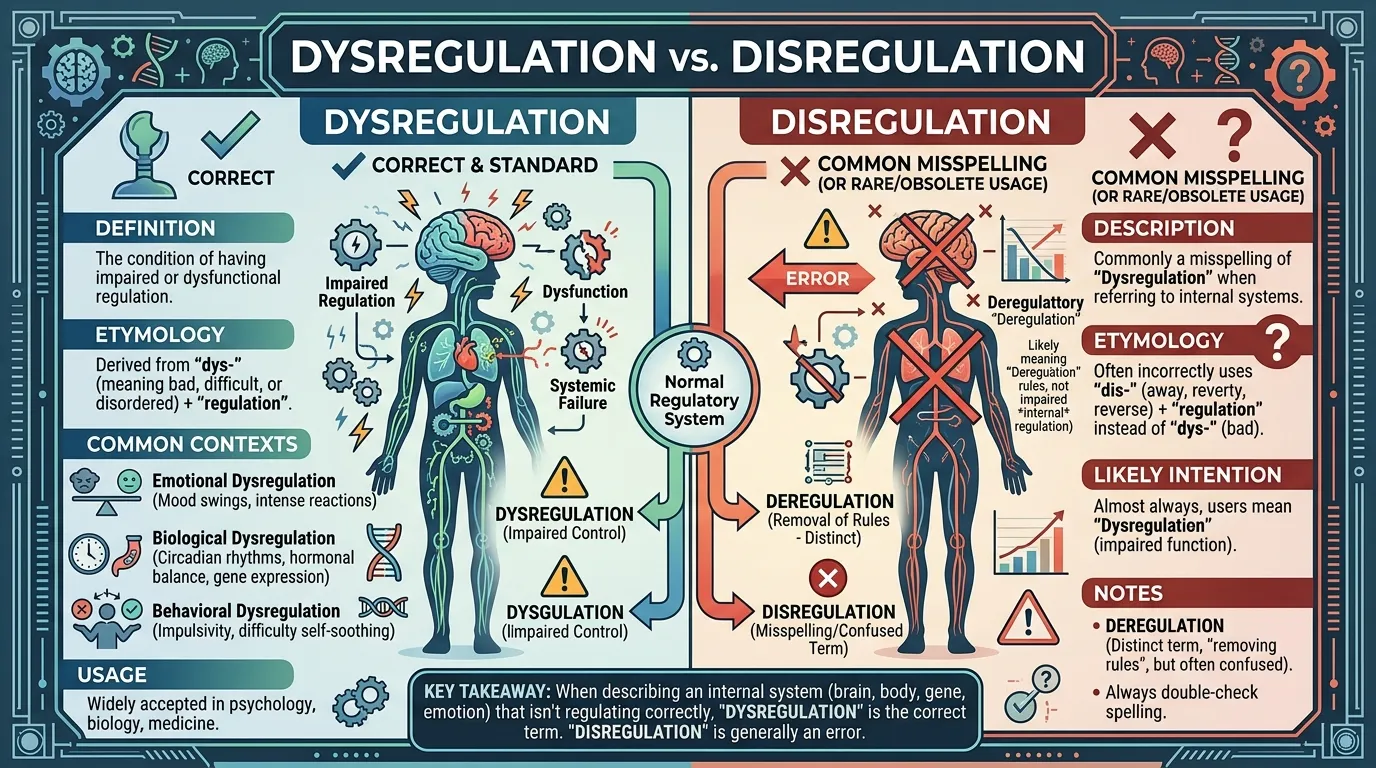
Have you ever seen the words dysregulation and disregulation and wondered if they mean the same thing? I remember coming across both terms and thinking, “Wait, which one is actually correct?” They look almost identical, and people sometimes use them interchangeably online. However, there is an important difference in how these words are used, especially in psychology, medicine, education, and everyday discussions about emotions.
If you are searching for dysregulation vs disregulation, you probably want to know which word is correct and when to use each one. The short answer is that dysregulation is the much more common and established term, particularly when talking about emotional, behavioral, or physiological regulation.
Quick Answer: Dysregulation means impaired, disrupted, or poorly controlled regulation. It’s a formal term commonly used to describe difficulty regulating emotions, behavior, attention, or body processes.
🧠 What Does Dysregulation vs Disregulation Mean?
Dysregulation and disregulation are similar-looking words, but they are not equally common in modern English.
What Is Dysregulation?
Dysregulation refers to a problem or difficulty with a system’s normal ability to regulate itself.
The prefix dys- generally suggests something is abnormal, impaired, difficult, or functioning poorly. Therefore, dysregulation can describe a situation where regulation is not working effectively.
For example:
She experienced emotional dysregulation after a stressful day.
This means she had difficulty managing or controlling her emotional response.
The word can appear in several contexts, including:
- Emotional dysregulation
- Behavioral dysregulation
- Nervous system dysregulation
- Sleep dysregulation
- Blood sugar dysregulation
- Attention dysregulation
What Is Disregulation?
Disregulation is a less common term. In some contexts, people use it to mean a failure, disruption, or removal of regulation. However, it is much less established than dysregulation in many modern professional contexts.
This is why you will generally see dysregulation used when discussing emotional or psychological regulation.
For example:
Emotional dysregulation can make it difficult to calm down after an upsetting event.
That wording is more natural and widely recognized than “emotional disregulation.”
In short: Dysregulation = impaired regulation = difficulty maintaining normal control or balance.
📱 Where Is Dysregulation Commonly Used?
Unlike texting slang such as “LOL” or “BRB,” dysregulation is not really a casual internet abbreviation. It is a real English term that can appear in both professional and everyday conversations.
You may encounter it in:
- 🧠 Psychology discussions
- 🩺 Medical and health-related writing
- 👩🏫 Education and child development
- 📚 Academic articles
- 💬 Mental-health conversations online
- 📱 TikTok, Instagram, Reddit, and other social platforms
- 🗣️ Everyday conversations about emotions
On social media, people may say things like:
“i’m feeling emotionally dysregulated today.”
Here, the term is being used casually even though the word itself is formal.
Is Dysregulation Formal or Casual?
Dysregulation is primarily a formal or semi-formal term, but it has become increasingly common in casual online conversations.
It is appropriate in professional writing when the context supports it. In casual conversation, simpler alternatives such as “I’m having trouble managing my emotions” may sound more natural.
💬 Examples of Dysregulation in Conversation
Here are some realistic examples showing how people might use dysregulation in texting and online conversations:
A: why did that tiny thing make me so upset 😭
B: sounds like emotional dysregulation honestly.
A: i’ve been super overwhelmed today.
B: yeah, stress can make emotional regulation harder.
A: my kid had a huge meltdown after school.
B: that could be a sign of dysregulation.
A: why can’t i calm down even though i know everything is okay?
B: sometimes your nervous system needs time to regulate.
A: social media has me feeling all over the place today 😵💫
B: honestly, that constant stimulation can feel dysregulating.
A: is “disregulation” the right spelling?
B: “dysregulation” is the more commonly used term.
A: i went from totally fine to crying in five minutes.
B: sounds like you’re having a hard time regulating your emotions.
These examples show that dysregulation can appear in casual texting, but it is not traditional texting slang.
🕓 When to Use and When Not to Use Dysregulation
✅ When To Use
Use dysregulation when:
- You are discussing difficulty controlling emotions.
- You are talking about behavioral regulation.
- You are writing about psychology or mental health.
- You are discussing nervous-system responses.
- You are explaining a child’s emotional or behavioral response.
- You are writing an academic or professional article.
- You want a specific term rather than a general phrase.
❌ When Not To Use
Avoid using dysregulation when:
- A simpler phrase would be clearer.
- You are writing for someone unfamiliar with the terminology.
- You are making a very casual statement where “upset” or “overwhelmed” is enough.
- You are trying to diagnose yourself or someone else based on one emotional reaction.
- You are writing a formal message but using the word without explaining what you mean.
Dysregulation vs Simple Alternatives
| Context | Example Phrase | Why It Works |
| Friend Chat | “i’m so dysregulated today 😭” | Casual and understandable online |
| Work Chat | “I’m feeling overwhelmed today.” | Clear and professional |
| “I’m having difficulty managing the current workload.” | Formal and precise | |
| Academic Writing | “Emotional dysregulation may affect behavioral responses.” | Appropriate technical terminology |
| Family Conversation | “They’re having trouble calming down.” | Simple and easy to understand |
The key is to match the vocabulary to your audience. Dysregulation is useful when you need precision, but simpler language may communicate the idea better.
🔄 Similar Slang Words or Alternatives
If dysregulation feels too technical, several other words and phrases can communicate a similar idea.
| Word or Phrase | Meaning | When to Use |
| Emotional overwhelm | Feeling unable to handle strong emotions | Casual conversations |
| Emotional instability | Difficulty maintaining emotional balance | General descriptions |
| Difficulty regulating | Trouble controlling or managing a response | Everyday conversations |
| Overwhelmed | Feeling mentally or emotionally overloaded | Casual texting |
| Out of control | Unable to manage a reaction or situation | Informal speech |
| Poor regulation | Regulation that is not working effectively | Professional or educational contexts |
Dysregulation vs Disregulation
The most important distinction is simple:
Dysregulation is the more established and commonly preferred word when referring to impaired regulation.
Disregulation does appear occasionally, but it is considerably less common and may be viewed as an unnecessary or less-standard alternative depending on the context.
If you are writing an article, school assignment, professional document, or social-media post, dysregulation is generally the safer choice when you mean difficulty or disruption in regulation.
❓ FAQs
1. Is dysregulation the correct word?
Yes. Dysregulation is the widely used term for impaired, disrupted, or ineffective regulation.
2. Is disregulation a real word?
Disregulation is used in some contexts, but it is much less common than dysregulation.
3. What does dysregulation mean?
Dysregulation means difficulty maintaining normal control or balance within a system, such as emotions, behavior, attention, or physiological processes.
4. Is emotional dysregulation a common phrase?
Yes. Emotional dysregulation is a commonly used phrase describing difficulty managing or responding to emotions effectively.
5. Is dysregulation a medical term?
It can be used in medical and psychological contexts, although its exact meaning depends on the system or process being discussed.
6. Can I use dysregulation in casual texting?
Yes. People increasingly use the word casually, especially online when talking about emotions and stress.
7. Is dysregulation the same as being upset?
Not exactly. Being upset is a normal emotional state, while dysregulation generally emphasizes difficulty managing or returning from an emotional response.
8. What is the opposite of dysregulation?
Depending on the context, the opposite may be described as regulation, self-regulation, or effective emotional regulation.
9. Why do people say dysregulation instead of disregulation?
The prefix dys- commonly indicates impaired or abnormal functioning, making dysregulation the established term in many professional contexts.
10. Is dysregulation a diagnosis?
No. Dysregulation itself is not necessarily a diagnosis. It is a descriptive term used in various contexts.
11. What is emotional dysregulation?
Emotional dysregulation refers to difficulty managing emotional reactions or returning to an emotionally balanced state.
12. Can stress cause dysregulation?
Stress can contribute to difficulties with emotional, behavioral, or physiological regulation, depending on the individual and situation.
13. Is dysregulation only about emotions?
No. The term can refer to different systems and processes, including behavior, attention, sleep, and physiological functions.
14. Which spelling should I use: dysregulation or disregulation?
In most situations, dysregulation is the preferred and more widely recognized choice.
15. Is dysregulation formal?
Yes. It is generally considered a technical or professional term, although it is increasingly used in casual online conversations.
16. Can children experience dysregulation?
The term is commonly used when discussing children who have difficulty managing strong emotions, behavior, transitions, or sensory experiences.
17. Is dysregulation the same as overreacting?
Not necessarily. Calling something dysregulation describes difficulty with regulation; it does not automatically mean the person’s reaction is inappropriate.
18. Can I use dysregulation in an essay?
Yes, especially if your essay discusses psychology, education, behavior, neuroscience, or another relevant subject. Make sure the meaning is clear from context.
19. What is a simple way to explain dysregulation?
A simple explanation is: “Dysregulation means having difficulty keeping a response, emotion, or system balanced or under control.”
20. What is the main difference between dysregulation and disregulation?
The biggest difference is usage. Dysregulation is the much more established and commonly used term, while disregulation is comparatively uncommon.
Conclusion
When comparing dysregulation vs disregulation, the easiest rule to remember is to choose dysregulation in most contexts. It is the established term used to describe impaired or disrupted regulation, especially when discussing emotions, behavior, attention, or physiological processes.
Although disregulation can be found in some writing, it is far less common. If you are unsure which word to use, dysregulation will usually be the clearer and more recognizable choice.