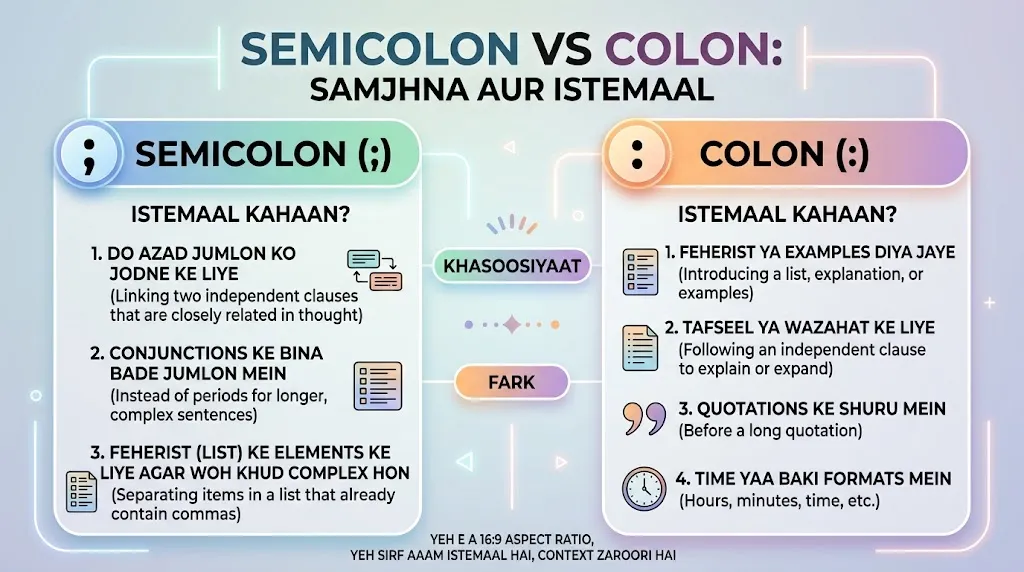
A semicolon (;) connects two closely related independent clauses or separates complicated list items. A colon (: ) introduces information that explains, expands, illustrates, or lists what came before it. In simple terms, use a semicolon to connect related ideas and a colon to introduce what comes next.
Key Takeaways
- A semicolon (;) usually connects two related complete thoughts.
- A colon (:) usually introduces a list, explanation, example, quotation, or expansion.
- Both marks have different jobs, so they are not normally interchangeable.
- A semicolon can separate items in a complicated list when those items already contain commas.
- Before using a colon to introduce a list, make sure the words before it form a complete sentence.
What Is the Difference Between a Semicolon and a Colon?
The easiest way to understand semicolon vs colon is to think about the relationship between the information on each side.
A semicolon connects two independent clauses that are closely related. Both parts could stand alone as complete sentences.
I wanted to go outside; it started raining.
You could write:
I wanted to go outside.
It started raining.
The semicolon keeps these related thoughts together.
A colon, on the other hand, points forward. It tells the reader that the information coming next will explain, expand, illustrate, or list something mentioned before it.
I need three things: a notebook, a pen, and a charger.
The words before the colon form a complete thought: “I need three things.” The colon then introduces those three things.
This basic distinction is also reflected in current grammar guidance: semicolons generally connect related independent clauses, while colons introduce or expand information.
When to Use a Semicolon
Connecting Two Related Independent Clauses
The most common use of a semicolon is to join two independent clauses that are closely connected.
An independent clause contains a subject and verb and can stand on its own as a sentence.
For example:
The store was closing; we hurried to the checkout.
Both parts are complete:
- The store was closing.
- We hurried to the checkout.
The semicolon shows that the two statements are connected without adding a coordinating conjunction such as and or but.
More examples:
I finished my homework; I watched a movie.
The weather was cold; we stayed inside.
Maria loves reading; her brother prefers hiking.
The relationship between the ideas can be causal, sequential, contrasting, or simply closely connected.
Using Semicolons in Complex Lists
Semicolons can also separate items in a list when the individual items already contain commas.
For example:
Our guests came from Austin, Texas; Denver, Colorado; Portland, Oregon; and Miami, Florida.
Using only commas would make the list difficult to read because the reader could confuse the city-state pairs with separate list items.
The semicolons create clearer boundaries between the larger items.
Another example:
The team included Sarah, the designer; James, the developer; and Maria, the project manager.
This is a useful distinction to remember: colons can introduce a list, while semicolons can separate complicated items within a list.
Semicolons With Words Like However and Therefore
A semicolon can also appear before a conjunctive adverb such as however, therefore, moreover, consequently, or nevertheless when it connects two independent clauses.
For example:
I wanted to attend the meeting; however, I had another appointment.
The forecast looked bad; therefore, we canceled the picnic.
The semicolon separates the two complete clauses, while the conjunctive adverb shows the relationship between them.
When to Use a Colon
Introducing a List
One of the most familiar uses of a colon is to introduce a list.
Bring these items: your ID, notebook, and laptop.
She bought three fruits: apples, oranges, and bananas.
We need four things: time, patience, practice, and consistency.
The important point is that the words before the colon should form a complete sentence.
Correct:
I bought three things: bread, milk, and eggs.
Incorrect:
My favorite foods are: pizza, tacos, and pasta.
The second example is generally better without the colon:
My favorite foods are pizza, tacos, and pasta.
MLA guidance likewise recommends using a colon before a list only when the introductory words constitute a complete sentence.
Introducing an Explanation or Example
A colon can introduce an explanation of the idea that came before it.
She had one goal: to finish the project on time.
The phrase after the colon explains the goal.
Another example:
There was one problem: nobody had the key.
The second part explains what the problem was.
A colon can also introduce an example:
Some animals are active at night: owls, bats, and raccoons.
Here, the examples explain which animals are being discussed.
Introducing a Quotation or Related Sentence
A colon can introduce a quotation when the quotation is formally introduced rather than grammatically integrated into the sentence.
The teacher gave us one important rule: “Always check your work.”
It can also introduce a related sentence or a larger explanation:
She knew what she had to do: She needed to start over.
In American English, capitalization after a colon depends on what follows. A lowercase letter is generally appropriate when the following material is not a complete sentence requiring capitalization, while a capital may be used when the colon introduces a rule, several related sentences, or a proper noun.
Semicolon vs Colon: Side-by-Side Comparison
| Feature | Semicolon (;) | Colon (:) |
| Main purpose | Connects related ideas | Introduces information |
| Common use | Two independent clauses | Lists and explanations |
| Can join complete clauses? | Yes | Yes, in certain explanatory relationships |
| Introduces a basic list? | No | Yes |
| Separates complex list items? | Yes | No |
| Introduces an explanation? | Usually no | Yes |
| Symbol | ; | : |
| Easy memory | Connect | Introduce |
The key difference is the direction of the relationship.
A semicolon generally says:
These two thoughts belong together.
A colon generally says:
Here is the information that explains or expands the thought before it.
Semicolon vs Colon Examples
Examples With a Semicolon
The movie was long; we still enjoyed it.
I wanted to call her; it was too late.
The restaurant was crowded; we found another place nearby.
John studied all night; he passed the exam.
In each example, both sides of the semicolon can function as complete sentences.
Examples With a Colon
I packed three essentials: water, food, and a flashlight.
She had one request: please arrive on time.
We had a simple plan: finish the work before lunch.
He finally understood the problem: the file was saved in the wrong folder.
In these examples, the colon introduces information that follows logically from the first part.
Compare the Same Idea
Consider these two sentences:
The road was icy; we drove slowly.
Here, the semicolon simply connects two related statements.
Now compare:
The road was icy: driving fast would have been dangerous.
The colon creates a stronger explanatory relationship. The second clause explains the significance of the first.
MLA describes this distinction as a difference in the type of connection: a semicolon can connect clauses in several ways, while a colon can signal that the second clause expands or explains the first.
Common Mistakes to Avoid
Mistake 1: Using a Semicolon Before a Simple List
Incorrect:
I bought three items; apples, bread, and cheese.
Better:
I bought three items: apples, bread, and cheese.
The colon introduces the list.
Mistake 2: Using a Colon After an Incomplete Phrase
Incorrect:
My favorite hobbies are: reading and hiking.
Better:
My favorite hobbies are reading and hiking.
The phrase “My favorite hobbies are” already leads directly into the list, so the colon is unnecessary.
Mistake 3: Using a Semicolon After a Dependent Clause
Incorrect:
Because it was raining; we stayed home.
Better:
Because it was raining, we stayed home.
A semicolon normally connects independent clauses. “Because it was raining” cannot stand alone as a complete sentence.
Mistake 4: Treating the Two Marks as Interchangeable
Consider:
She brought several things: a notebook, a pen, and a charger.
A semicolon would not perform the same job here.
Likewise:
She brought a notebook; she needed it for class.
A colon could change the relationship between the ideas and may not communicate the intended meaning.
An Easy Trick to Remember Semicolon vs Colon
If you frequently confuse these punctuation marks, use this simple test.
Think “Connection” for a Semicolon
Ask:
Do I have two closely related complete sentences?
If yes, a semicolon may work.
The meeting ended; everyone left the room.
You could replace the semicolon with a period:
The meeting ended. Everyone left the room.
That is a useful clue.
Think “Introduction” for a Colon
Ask:
Is the second part explaining, listing, or expanding on the first?
If yes, consider a colon.
I need one thing: your attention.
We packed everything we needed: food, water, and blankets.
A useful mental shortcut is:
Semicolon = connect.
Colon = introduce.
This is not a complete grammar rule, but it is a practical way to remember the central difference.
Frequently Asked Questions
Can a colon and semicolon be used interchangeably?
Usually, no. A semicolon generally connects closely related independent clauses, while a colon introduces a list, explanation, example, quotation, or expansion. There are situations where both can connect two independent clauses, but they communicate different relationships. A colon specifically signals that what follows expands on or explains what came before.
Does a colon come after a complete sentence?
When a colon introduces a list or explanation, the material before the colon should normally form a complete sentence. For example, “I need three things: a pen, paper, and a folder.” Avoid placing a colon after an incomplete phrase such as “I need: a pen and paper.”
Can you use a semicolon before a list?
A semicolon does not normally introduce a simple list. However, semicolons can separate individual items in a complex list, especially when those items already contain commas.
Example:
The conference included speakers from Austin, Texas; Boston, Massachusetts; and Seattle, Washington.
Should you capitalize after a colon?
Not automatically. In American English, capitalization depends on what follows the colon. A lowercase word is common when the colon introduces a phrase or ordinary explanation. A capital letter may be appropriate when the colon introduces a complete sentence, a rule or principle, several related sentences, or a proper noun. Follow the style guide required for your specific type of writing.
What is the simplest way to remember the difference?
Remember two words:
Semicolon = connection.
Colon = introduction.
Use a semicolon when two closely related complete thoughts need to stay together. Use a colon when the second part explains, illustrates, or lists information connected to the first.
Final Takeaway
The difference between a semicolon vs colon becomes much easier once you focus on what the punctuation is doing.
A semicolon connects related independent clauses or separates complicated items in a list. A colon points forward to information that explains, expands, or illustrates what came before it.
When you’re unsure, check the relationship between the two parts. If you’re joining two complete, closely related thoughts, a semicolon may be appropriate. If you’re introducing a list, explanation, example, or expansion, a colon is usually the better choice.
The goal is not to use sophisticated punctuation simply because it looks formal. The goal is to make the relationship between your ideas clear to the reader.