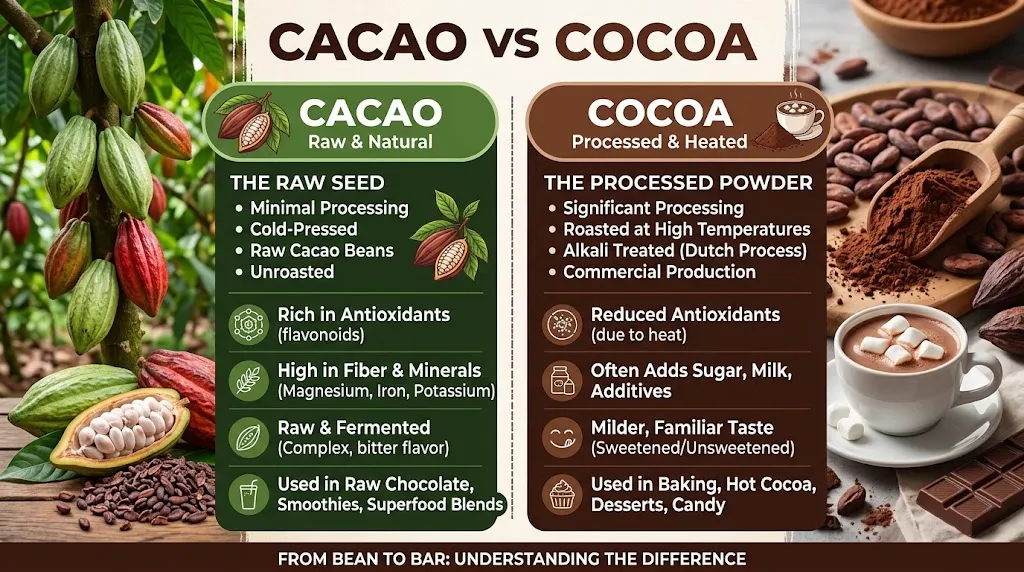
Cacao and cocoa come from the same plant, Theobroma cacao, but the terms are often used differently depending on the product and how it is processed. “Cacao” commonly refers to the plant, beans, or less-processed products, while “cocoa” often refers to roasted or processed products such as cocoa powder. However, the words are not a perfect guarantee of processing, so check the product label.
Key Takeaways
- Cacao and cocoa ultimately come from the same cacao tree.
- “Cacao” often describes the bean, plant, or less-processed products.
- “Cocoa” commonly describes processed products such as cocoa powder.
- Roasting and alkalizing can change flavor, color, acidity, and some naturally occurring compounds.
- For baking, the important detail is often whether cocoa is natural or Dutch-processed, not simply whether the package says cacao or cocoa.
What Is Cacao?
Cacao comes from the Theobroma cacao tree. The tree produces large pods containing seeds commonly called cacao beans. Those beans are fermented and dried before they are turned into ingredients such as nibs, powder, cocoa butter, and chocolate.
In everyday English, cacao is often used when talking about the tree, pods, beans, nibs, or products marketed as minimally processed. You may see terms such as cacao nibs, cacao beans, and cacao powder in natural-food stores.
However, there is an important detail: the word “cacao” by itself does not prove that a product is raw or minimally processed. Different manufacturers can use the terminology differently.
The USDA’s Agricultural Thesaurus, for example, lists cacao powder as a synonym for cocoa powder, showing how much the terminology can overlap.
What Is Cocoa?
Cocoa is another common term connected to the same cacao plant and its products. In the kitchen, cocoa powder usually means the dry powder produced after cacao beans are processed and much of their cocoa butter is removed.
Cocoa powder is widely used in brownies, cakes, cookies, frostings, hot cocoa, sauces, and other chocolate-flavored foods.
The FDA recognizes standards for cacao products under 21 CFR Part 163, while FDA ingredient resources also use both cacao and cocoa terminology. This is one reason it is more accurate to look at the specific product and processing method rather than assume the spelling tells you everything.
Cacao vs Cocoa: What Is the Main Difference?
The simplest way to understand cacao vs cocoa is to look at the processing.
| Feature | Cacao | Cocoa |
| Source | Theobroma cacao | Theobroma cacao |
| Common meaning | Plant, beans, nibs, or less-processed products | Processed cocoa products, especially powder |
| Roasting | May be unroasted or lightly processed | Often roasted |
| Flavor | Often sharper, more bitter, or fruity | Usually deeper and more familiar as “chocolate” |
| Acidity | Often more noticeable | Can be reduced through processing |
| Baking use | Can work in many recipes | Common traditional baking ingredient |
| Dutch processing | Not necessarily | Some cocoa powders are alkalized |
| Does the name guarantee processing? | No | No |
The key point is that cacao and cocoa are not two completely different plants or foods. They are connected to the same raw material, and the terminology overlaps.
How Does Processing Change Cacao Into Cocoa?
After cacao pods are harvested, their seeds go through several stages. Fermentation and drying are important early steps because they help develop the characteristic flavors associated with chocolate.
For conventional cocoa products, the beans may then be roasted, crushed, ground, and pressed. Grinding produces a chocolate-like mass containing cocoa solids and cocoa butter. Pressing removes much of the fat, leaving a solid material that can be milled into cocoa powder.
This processing can affect the final ingredient in several ways.
Roasting
Roasting develops a deeper, more familiar chocolate flavor. It also changes the chemical composition of the beans.
That does not automatically mean roasted cocoa is “bad.” Roasting is an important part of producing the flavor and characteristics people expect from many chocolate products.
Alkalizing or Dutch Processing
Some cocoa powder is treated with an alkaline substance. This is commonly called Dutch processing.
Alkalizing reduces acidity and can produce a darker color and smoother, less sharp flavor. It can also affect some naturally occurring compounds in cocoa.
This distinction matters in baking because natural cocoa and Dutch-process cocoa can behave differently in recipes.
Is Cacao Healthier Than Cocoa?
This is one of the most common questions about cacao vs cocoa, but there is no simple rule that says cacao is always healthier.
Cacao products can contain naturally occurring compounds such as flavanols, and cocoa products can contain them as well. Processing can influence the amount of some of these compounds. Healthline notes that both cacao and cocoa products can provide antioxidant compounds, while also emphasizing that chocolate products can vary substantially depending on processing and ingredients.
The word cacao on a package should therefore not be treated as a guarantee that the product has more nutrients or health benefits.
Instead, check:
- Whether the product is roasted
- Whether it is alkalized
- Whether sugar has been added
- The ingredient list
- The nutrition facts panel
- The serving size
- The amount of cocoa or cacao actually present
In other words, processing and the complete ingredient list tell you more than the spelling alone.
Cacao Powder vs Cocoa Powder for Baking
If you’re standing in the baking aisle and wondering which powder to buy, the answer depends on your recipe.
Natural Cocoa Powder
Natural cocoa powder is relatively acidic. It is commonly paired with baking soda in recipes designed around that acidity.
It has a strong, slightly sharp chocolate flavor and is a familiar ingredient in many American baking recipes.
Dutch-Process Cocoa Powder
Dutch-process cocoa has been alkalized to reduce acidity. It tends to have a smoother taste and darker color.
Because its acidity is different, it may not behave the same way as natural cocoa in recipes that depend on an acid-base reaction for leavening.
Cacao Powder
Cacao powder can often be used in similar ways to unsweetened cocoa powder, but the exact characteristics depend on the product.
If a recipe specifically calls for natural cocoa powder, check the cacao powder’s label and processing information before assuming it will perform identically.
Best rule: follow the recipe’s instructions when the type of cocoa powder is specified.
Can You Substitute Cacao for Cocoa?
Sometimes, yes.
For simple uses such as smoothies, oatmeal, energy bites, or homemade chocolate drinks, substitution is usually straightforward because you are primarily looking for a chocolate flavor.
Baking requires more care. If the recipe depends on the acidity of natural cocoa powder, replacing it with an alkalized cocoa product can change the chemical balance of the recipe.
For example:
Recipe calls for natural cocoa + baking soda:
Use natural cocoa or a product with comparable acidity.
Recipe calls for Dutch-process cocoa:
Use Dutch-process cocoa when possible.
Recipe simply calls for unsweetened cocoa powder:
Check the recipe context and the product label before making a substitution.
The most important information is often natural vs. Dutch-process, rather than simply cacao vs. cocoa.
Does Cacao Taste Different From Cocoa?
It can.
Cacao products are often described as having a more intense, bitter, acidic, earthy, or fruity flavor. Cocoa powder can have a more familiar roasted-chocolate taste, although the exact flavor depends on the beans and processing method.
Dutch-process cocoa is generally smoother and less acidic than natural cocoa.
So if you’re making a smoothie, you might enjoy the stronger character of cacao. If you’re making a classic American chocolate cake, the cocoa specified by the recipe may give you a more predictable result.
Cacao vs Cocoa: Which One Should You Buy?
There isn’t one universal choice for everyone.
Choose cacao if:
- You want cacao nibs or a less-processed-style product.
- You like a stronger, more bitter chocolate flavor.
- You are adding powder to smoothies, oatmeal, or snack recipes.
- You have checked the label and prefer the product’s particular processing method.
Choose cocoa if:
- You are following a traditional baking recipe.
- You want familiar cocoa powder flavor.
- Your recipe specifies natural or Dutch-process cocoa.
- You want a product that is easy to find in the standard baking aisle.
If health is your main reason for buying one, don’t rely only on the word cacao. Compare the actual ingredients and processing information.
Common Mistakes About Cacao and Cocoa
Mistake 1: Thinking they come from different plants
They do not. Both terms ultimately relate to the Theobroma cacao plant.
Mistake 2: Assuming cacao always means raw
Not necessarily. “Cacao” is commonly associated with less-processed products, but the label itself does not give you a universal guarantee about processing.
Mistake 3: Assuming cocoa is automatically unhealthy
Cocoa itself is not the same thing as a sugary chocolate candy. Unsweetened cocoa powder can be an ingredient with a very different nutritional profile from a sweetened chocolate product.
Mistake 4: Ignoring Dutch processing
For baking, whether cocoa is natural or alkalized can matter more than whether the package uses the word cacao or cocoa.
Frequently Asked Questions
Is cacao the same as cocoa?
They come from the same plant, Theobroma cacao, and the terms can overlap. Cacao commonly refers to the plant, beans, nibs, or less-processed products, while cocoa often refers to processed products such as cocoa powder. However, the terminology is not a perfect processing classification.
Which is better, cacao or cocoa?
Neither is automatically better for every purpose. The better choice depends on what you are making and what characteristics you want. For baking, natural versus Dutch-process cocoa can be especially important. For nutrition, compare the actual product’s ingredients and processing rather than relying only on the name.
Can I use cacao powder instead of cocoa powder?
Often, but not always without adjustments. For smoothies and other simple foods, substitution is usually easy. For baking, check whether the recipe requires natural or Dutch-process cocoa because acidity can affect how the ingredients react.
Is cacao more nutritious than cocoa?
Processing can affect naturally occurring compounds in cacao, including flavanols, but the word “cacao” alone does not guarantee a higher nutritional value. Products differ in processing, composition, and serving size, so the label is more useful than the name alone.
Is Dutch-process cocoa the same as cacao?
No. Dutch processing refers to an alkalization process used on cocoa. Cacao is a broader term that can refer to the plant, beans, or certain cacao products. A package labeled cacao is not automatically unprocessed or non-alkalized.
The Bottom Line on Cacao vs Cocoa
The cacao vs cocoa debate is less complicated once you know where the two terms overlap. Both come from Theobroma cacao, and the words are sometimes used interchangeably. In common U.S. food language, cacao often points toward the plant, beans, nibs, or less-processed products, while cocoa commonly refers to roasted and processed products such as cocoa powder.
But don’t judge a product by the name alone. If you’re baking, look specifically for natural or Dutch-process cocoa. If you’re buying cacao for nutrition or everyday use, check the ingredients and processing information.
Once you understand those labels, choosing between cacao and cocoa becomes much easier.