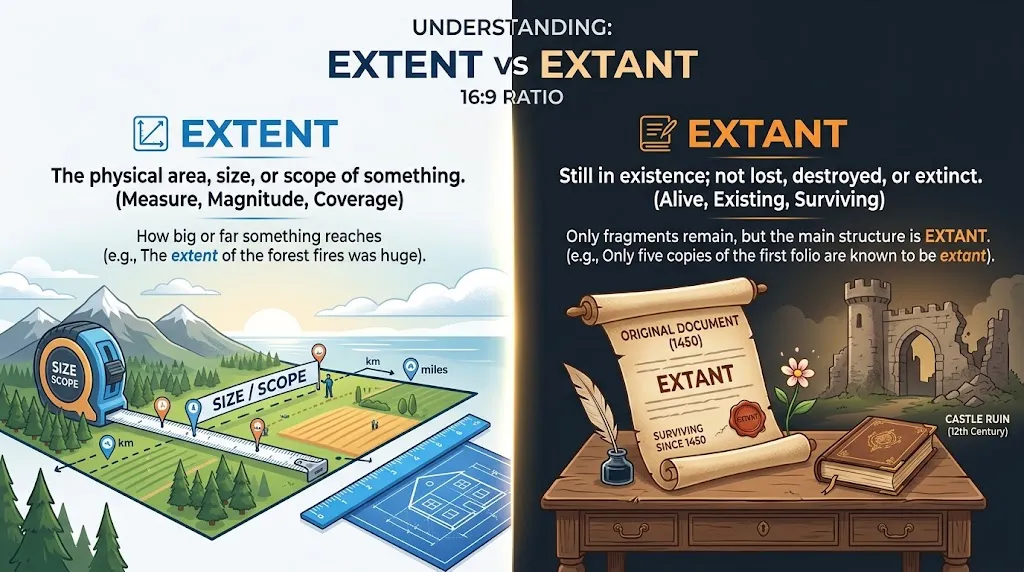
Have you ever typed a sentence and suddenly wondered whether you should write extent or extant? I remember seeing these two words and thinking they looked almost identical, so surely they must mean nearly the same thing.
But they actually have completely different meanings. Extent is about the size, degree, or range of something, while extant describes something that still exists today. They are especially easy to confuse because they sound somewhat similar. If you are writing an email, essay, social media post, or even a quick message, knowing the difference can help you avoid an awkward mistake.
Quick Answer: Extent means “the size, degree, or range of something,” while extant means “still existing.” Both are standard English words, but they are used in different contexts.
🧠 What Does Extent vs Extant Mean?
The easiest way to understand extent vs extant is to remember that these words answer different questions.
Extent is a noun. It refers to how much, how far, or how large something is.
For example:
We don’t yet know the extent of the damage.
Here, extent means the amount or seriousness of the damage.
Extant is an adjective. It means still existing, surviving, or remaining from an earlier time.
For example:
This is one of the oldest extant copies of the manuscript.
Here, extant means that the copy still exists.
A simple memory trick
Think:
- Extent = amount, size, degree, or range
- Extant = existing or surviving
In short: Extent = size/degree/range = how much or how far. Extant = still existing = what remains.
📱 Where Is Extent vs Extant Commonly Used?
Unlike internet slang, extent and extant are normal English vocabulary words. You may see them in everyday writing, academic work, news, books, and professional communication.
- 💬 Texting: “i didn’t realize the extent of the problem.”
- 📚 Academic writing: “Researchers examined the extent of the impact.”
- 📰 News articles: “Officials are assessing the extent of the damage.”
- 🏛️ History: “Only a few extant documents remain.”
- 🔬 Research: “The study examines the extent of the environmental changes.”
- 💼 Work communication: Both can appear in professional writing.
Extent is fairly common in everyday and professional English. Extant is much less common and tends to sound formal, academic, historical, or literary.
So, neither word is really “slang.” They are standard English terms.
💬 Examples of Extent vs Extant in Conversation
Because these words have different meanings, context makes the distinction clear.
Example 1
A: how bad is the situation?
B: we’re still trying to understand the extent of the problem.
Example 2
A: does that old document still exist?
B: yes, it’s one of the few extant records from that period.
Example 3
A: did the storm damage the whole area?
B: we don’t know the full extent of the damage yet.
Example 4
A: are there any original paintings left?
B: only a few extant works are known today.
Example 5
A: how much did the prices increase?
B: the extent of the increase surprised everyone.
Example 6
A: is the ancient manuscript still around?
B: yes, an extant copy is kept in the museum.
Example 7
A: can you tell me how serious the issue is?
B: not yet. we need to determine its full extent.
🕓 When to Use and When Not to Use Extent vs Extant
✅ When To Use “Extent”
Use extent when you are talking about:
- 📏 Size or range
- 📈 Degree or amount
- 🌎 How far something reaches
- ⚠️ The seriousness of a problem
- 📊 The level of an effect or impact
Example:
“The extent of the damage was greater than expected.”
✅ When To Use “Extant”
Use extant when describing something that:
- 🏛️ Still exists
- 📜 Has survived from the past
- 📚 Remains available or preserved
- 🕰️ Is still in existence despite its age
Example:
“This is the oldest extant version of the text.”
❌ When Not To Use “Extent”
Don’t use extent when you mean that something still exists.
Incorrect:
This is the oldest extent manuscript.
Better:
This is the oldest extant manuscript.
❌ When Not To Use “Extant”
Don’t use extant when you mean amount, degree, or size.
Incorrect:
We need to understand the extant of the damage.
Better:
We need to understand the extent of the damage.
Quick Comparison
| Context | Example Phrase | Why It Works |
| Friend Chat | “i didn’t know the extent of it 😅” | Casual and natural |
| Work Chat | “We need to assess the extent of the issue.” | Professional and precise |
| “Please review the extent of the changes.” | Formal and clear | |
| Academic | “The study measured the extent of the effect.” | Appropriate for research |
| Historical Writing | “Few extant records remain.” | Describes surviving records |
🔄 Similar Words or Alternatives
| Word | Meaning | When to Use |
| Extent | Size, degree, or range | When describing how much or how far |
| Extant | Still existing | When something has survived |
| Existing | Currently present | Everyday situations |
| Surviving | Still remaining | Historical or general contexts |
| Degree | Level or amount | Describing intensity or seriousness |
| Range | Limits or scope | Describing how far something extends |
One useful point is that existing and surviving can often replace extant in simpler writing. For example, instead of saying “extant manuscripts,” you could say “surviving manuscripts.”
However, extent cannot normally be replaced by extant because they perform different grammatical jobs.
❓ FAQs :
1. What is the main difference between extent and extant?
Extent means size, amount, degree, or range. Extant means still existing or surviving.
2. Is extant the same as existing?
Yes, they are very similar. Extant is a more formal word for something that still exists.
3. What does extent mean?
Extent refers to the size, range, degree, or amount of something.
4. What does extant mean?
Extant describes something that continues to exist, especially something that has survived from the past.
5. Is extant a noun?
No. Extant is an adjective. For example, “an extant manuscript.”
6. Is extent a noun?
Yes. Extent is a noun, as in “the extent of the damage.”
7. Which word means “still existing”?
Extant means still existing or surviving.
8. Which word means “how much”?
Extent is the correct word when you mean how much, how far, or how great something is.
9. Is extant commonly used in texting?
Not usually. It is a formal word and is more common in academic, historical, or literary writing.
10. Is extent common in everyday English?
Yes. Phrases such as “the extent of the damage” and “to some extent” are common.
11. Can I say “to some extant”?
No. The correct phrase is “to some extent.”
12. Can I say “extant damage”?
Usually no, if you mean the amount of damage. You would normally say “extent of the damage.”
13. What is an example of extant?
“Several extant copies of the ancient book have been discovered.”
14. What is an example of extent?
“We don’t know the full extent of the problem.”
15. Do extent and extant sound the same?
They sound similar, but they are not identical. Their meanings are also completely different.
16. Is extant a formal word?
Yes. Extant is relatively formal and is especially common in academic and historical contexts.
17. Is extent formal or casual?
Extent works in both casual and formal English. Its exact tone depends on the sentence.
18. What is an easy way to remember extant?
Associate extant with existing. Both describe something that remains in existence.
19. What is an easy way to remember extent?
Think of extent as answering “how much?” or “how far?”
20. Which is correct: “extent of damage” or “extant of damage”?
The correct phrase is “extent of damage.” It means the amount or severity of the damage.
Concluson:
Understanding extent vs extant becomes much easier once you connect each word with its core meaning. If you’re talking about size, degree, amount, or range, choose extent. If you’re describing something that still exists or has survived, choose extant.
When in doubt, ask yourself: “Am I talking about how much, or am I talking about what still exists?” That simple question will usually point you to the right word.