Have you ever typed a sentence and suddenly stopped because you weren’t sure whether to write accept or except? You’re definitely not alone. These two words look and sound similar, but they have completely different meanings. I used to mix them up too, especially when writing quickly or replying to messages. The good news is that the difference is actually pretty simple once you know what each word does.
Accept is usually about receiving, agreeing, or saying yes, while except is about leaving something or someone out. In this guide, we’ll break down accept vs except with simple explanations, real examples, and an easy memory trick.
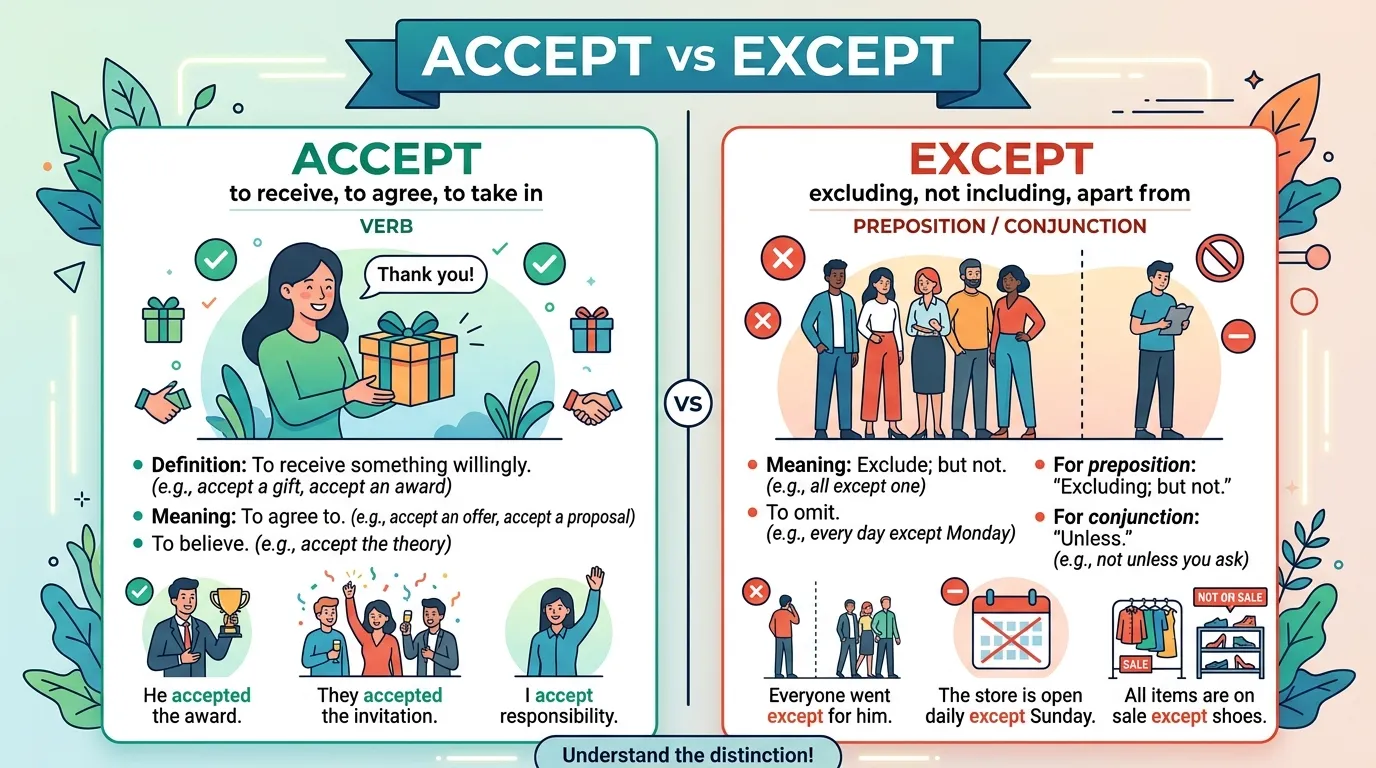
Quick Answer: Accept means “to receive, agree to, or approve something.” Except means “excluding or leaving something out.” Accept is commonly used as a verb, while except can work as a preposition, conjunction, or verb.
🧠 What Does Accept vs Except Mean?
The easiest way to understand accept vs except is to remember that they represent opposite ideas.
What Does Accept Mean?
Accept means to receive something willingly, agree to something, or approve something.
For example:
- I accept your apology.
- She accepted the job offer.
- He accepted the invitation.
In each sentence, something is being received or agreed to.
What Does Except Mean?
Except means excluding someone or something from a group, rule, or statement.
For example:
- Everyone came except Sarah.
- I eat everything except seafood.
- The store is open every day except Sunday.
Here, something or someone is being left out.
In short: Accept = receive or agree = say yes. Except = exclude = leave out.
📱 Where Are Accept and Except Commonly Used?
Unlike texting slang, accept and except are standard English words. You can find them almost everywhere:
- 💬 Texting: I accept your apology.
- 📱 Social media: Everyone liked the post except me.
- 📧 Emails: We accept your request.
- 🏫 School writing: All students attended except two.
- 💼 Work chats: I accept the terms.
- 📄 Formal writing: The application was accepted.
Both words can be used in casual, professional, and formal communication. The important thing is choosing the correct word based on the meaning you want.
💬 Examples of Accept vs Except in Conversation
Example 1
A: do you want to come to the party?
B: yes, i accept the invitation 😄
Here, accept means agreeing to receive the invitation.
Example 2
A: did everyone finish the assignment?
B: everyone did except ali.
Here, except means Ali was left out.
Example 3
A: can you accept my friend request?
B: sure 👍
The person is being asked to approve or receive the request.
Example 4
A: who is coming tonight?
B: everyone except john.
John is the only person excluded.
Example 5
A: will you accept my apology?
B: of course ❤️
Here, accept means agreeing to receive the apology.
Example 6
A: do you like all kinds of pizza?
B: almost all, except pineapple 😅
Pineapple is excluded from the group.
Example 7
A: i accept your offer.
B: great! let’s do it 🙌
The speaker agrees to the offer.
🕓 When to Use and When Not to Use Accept vs Except
✅ When To Use Accept
Use accept when you mean:
- Receiving something willingly
- Agreeing to an offer
- Approving a request
- Taking an invitation
- Agreeing with an apology
- Taking responsibility
Example: I accept your offer.
❌ When Not To Use Accept
Don’t use accept when you mean “excluding” someone or something.
Incorrect:
- Everyone came accept John.
Correct:
- Everyone came except John.
✅ When To Use Except
Use except when you mean:
- Excluding something
- Leaving someone out
- Making an exception
- Saying something applies to everyone but one person or thing
Example: Everyone was invited except Tom.
❌ When Not To Use Except
Don’t use except when you mean “receive” or “agree.”
Incorrect:
- I except your apology.
Correct:
- I accept your apology.
Accept vs Except Comparison
| Context | Example Phrase | Why It Works |
| Friend Chat | “i accept your apology 😄” | Shows agreement or receiving |
| Group Chat | “everyone came except sam” | Shows exclusion |
| Work Chat | “I accept the offer.” | Professional agreement |
| “All files are included except the invoice.” | Clearly identifies an exclusion | |
| Formal Writing | “The committee accepted the proposal.” | Shows official approval |
🔄 Similar Words or Alternatives
| Word | Meaning | When to Use |
| Receive | Get or take something | When something is given to you |
| Agree | Say yes or share an opinion | When accepting an idea or proposal |
| Approve | Officially agree to something | Work, business, or formal situations |
| Exclude | Leave someone or something out | When something is not included |
| Omit | Leave something out | Writing or formal situations |
| Reject | Refuse to accept something | When saying no to an offer or request |
A useful trick is to replace the word mentally. If receive, agree, or approve makes sense, you probably need accept. If exclude or leave out makes sense, you probably need except.
🧠 Easy Memory Trick for Accept vs Except
Still confused? Try this simple trick:
Accept = Agree
Both begin with the idea of saying yes.
Except = Exclude
Both begin with ex-, which can help remind you that something is being left outside or excluded.
For example:
- I accept the invitation. → I say yes.
- Everyone came except Mike. → Mike was excluded.
Another quick test:
👉 If you can replace the word with “receive” or “agree,” use accept.
👉 If you can replace it with “excluding” or “but not,” use except.
❓ FAQs
1. What is the main difference between accept and except?
Accept means to receive, agree, or approve something. Except means to exclude or leave someone or something out.
2. Is accept a verb?
Yes. Accept is primarily a verb, such as “I accept your offer.”
3. Is except a verb?
Except can be a verb, but it is commonly used as a preposition or conjunction to show exclusion.
4. What does accept mean in simple English?
Accept means to say yes to something, receive it, or approve it.
5. What does except mean in simple English?
Except means not including someone or something.
6. Is it “I accept your apology” or “I except your apology”?
The correct sentence is “I accept your apology.”
7. Is it “everyone came accept John”?
No. The correct sentence is “Everyone came except John.”
8. Can accept and except be used in formal writing?
Yes. Both are standard English words and are perfectly appropriate in formal writing.
9. How do you remember accept vs except?
Remember: accept = agree, while except = exclude.
10. Does accept mean yes?
Often, yes. When you accept an offer, invitation, or proposal, you are generally saying yes.
11. Does except mean excluding?
Yes. Except commonly means that someone or something is not included.
12. What is an example of accept?
“I accept your invitation to dinner.”
13. What is an example of except?
“Everyone finished the test except Mark.”
14. Which word means to approve?
Accept can mean to approve or agree to something.
15. Which word means to leave out?
Except means to leave out or exclude.
16. Are accept and except pronounced differently?
Yes. They have similar pronunciations, but the vowel sounds are different enough to distinguish them in careful speech.
17. Can except be used in a sentence with everyone?
Yes. For example: “Everyone was invited except Sarah.”
18. Can accept be used with an invitation?
Yes. For example: “She accepted the invitation.”
19. What is an easy synonym for accept?
Depending on the context, synonyms include receive, agree, approve, and take.
20. What is an easy synonym for except?
Depending on the sentence, synonyms include exclude, omit, leave out, and excluding.
Final Takeaway
The difference between accept vs except becomes much easier when you focus on the meaning rather than the spelling. Accept is about receiving, agreeing, or approving something, while except is about excluding or leaving something out.
Whenever you’re unsure, ask yourself: Am I saying yes? Use accept. Am I leaving something out? Use except. This simple trick can help you avoid one of the most common English word mix-ups in texts, emails, schoolwork, and everyday conversations.