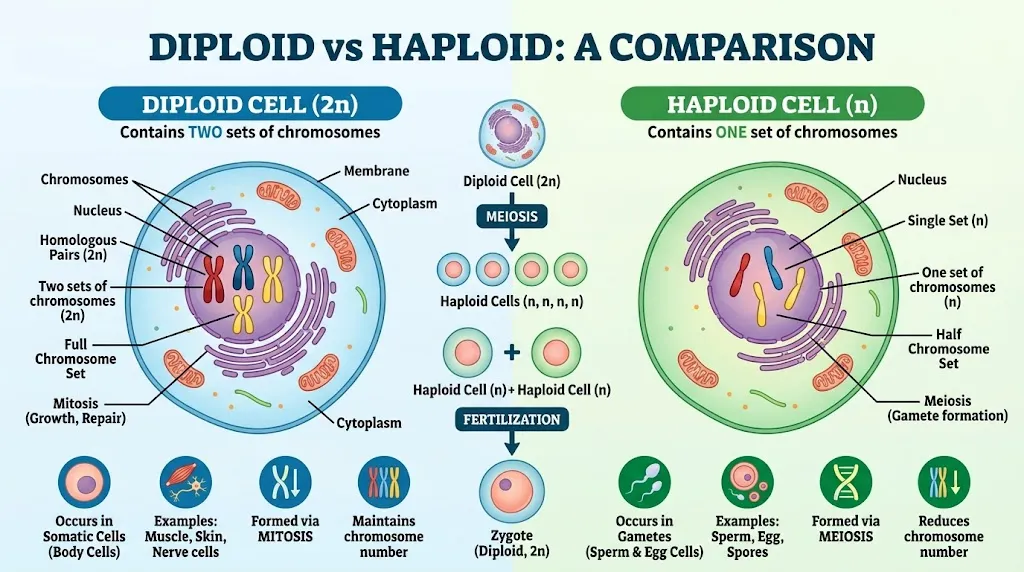
Diploid vs haploid describes the number of chromosome sets in a cell. A diploid cell has two complete sets of chromosomes, written as 2n, while a haploid cell has one set, written as n. In humans, most body cells are diploid with 46 chromosomes, while sperm and egg cells are haploid with 23 chromosomes.
Key Takeaways
- Diploid cells have two sets of chromosomes (2n).
- Haploid cells have one set of chromosomes (n).
- Most human body cells are diploid and contain 46 chromosomes.
- Human sperm and egg cells are haploid and contain 23 chromosomes.
- Meiosis produces haploid cells, while fertilization combines two haploid cells to form a diploid zygote.
What Is a Diploid Cell?
A diploid cell contains two complete sets of chromosomes. One set comes from each genetic parent. The two chromosomes in each matching pair are called homologous chromosomes because they contain the same types of genes in corresponding locations.
The word diploid is often represented by 2n. The “n” represents one complete set of chromosomes, so “2n” means two sets.
Humans are a familiar example. Most human body cells contain 46 chromosomes arranged in 23 pairs. One chromosome in each pair was inherited from the mother and the other from the father.
Examples of human diploid cells include most cells found in the:
- Skin
- Muscles
- Liver
- Bones
- Brain
- Other body tissues
These are generally called somatic cells, meaning cells of the body other than reproductive cells.
What Does 2n Mean?
The notation 2n does not simply mean “two chromosomes.” It means two complete chromosome sets.
For humans:
n = 23 chromosomes
2n = 46 chromosomes
This distinction is important because chromosome numbers differ between species. A diploid organism does not necessarily have 46 chromosomes. The number depends on the species.
What Is a Haploid Cell?
A haploid cell contains one complete set of chromosomes. It is represented by n.
In humans, haploid cells have 23 chromosomes. The main human examples are the reproductive cells, or gametes:
- Sperm cells
- Egg cells
Each gamete carries one chromosome from each chromosome pair. When sperm and egg unite during fertilization, their chromosome sets combine. This creates a diploid cell containing 46 chromosomes.
What Does n Mean?
The letter n represents one complete set of chromosomes.
For humans:
n = 23
A sperm cell has 23 chromosomes, and an egg cell has 23 chromosomes. When they combine:
23 + 23 = 46
The resulting fertilized egg, called a zygote, is diploid.
Diploid vs Haploid: Key Differences
The easiest way to understand diploid vs haploid is to compare their chromosome sets.
| Feature | Diploid | Haploid |
| Chromosome sets | Two | One |
| Symbol | 2n | n |
| Human chromosome number | 46 | 23 |
| Common human examples | Most body cells | Sperm and egg cells |
| Homologous chromosome pairs | Present | One chromosome from each pair |
| Role in reproduction | Forms most body tissues | Combines during fertilization |
| Produced by meiosis? | No, meiosis begins with a diploid cell | Yes |
| Created when gametes fuse? | Yes | No |
The key difference is the number of complete chromosome sets, not simply whether a cell is large, small, reproductive, or non-reproductive.
Diploid vs Haploid in Humans
Humans provide a simple example of how these two cell types work together.
Most human body cells are diploid (2n) and have 46 chromosomes. These chromosomes are organized into 23 pairs.
Human reproductive cells are haploid (n) and have 23 chromosomes.
This arrangement is necessary for sexual reproduction. If sperm and egg cells were both diploid, their fusion would normally produce a cell with 92 chromosomes. Instead, meiosis reduces the chromosome sets by half before fertilization.
Think of it like this:
Body cell → 46 chromosomes → diploid
Sperm → 23 chromosomes → haploid
Egg → 23 chromosomes → haploid
Sperm + egg → 46 chromosomes → diploid zygote
This cycle allows chromosome number to remain stable across generations.
How Meiosis Changes Diploid Cells Into Haploid Cells
Meiosis is a specialized form of cell division that produces haploid cells from a diploid starting cell. It involves one round of DNA replication followed by two rounds of nuclear division.
The two major stages are meiosis I and meiosis II.
Meiosis I
During meiosis I, homologous chromosomes separate.
A diploid starting cell has two chromosome sets. After meiosis I, the chromosome sets have been reduced so that each resulting cell has one chromosome from each homologous pair.
Importantly, the chromosomes at this point can still consist of two sister chromatids. This is why simply counting DNA strands or chromatids can sometimes cause confusion when learning the difference between haploid and diploid.
Meiosis II
During meiosis II, the sister chromatids separate.
The overall process generally produces four haploid cells from one diploid starting cell. In humans, these cells contribute to the formation of gametes.
Meiosis also contributes to genetic variation through processes such as chromosome assortment and crossing over.
How Fertilization Restores the Diploid Number
Meiosis reduces chromosome number, but fertilization brings the two sets back together.
In humans, a sperm contributes 23 chromosomes and an egg contributes 23 chromosomes. Their nuclei combine during fertilization, producing a diploid zygote with 46 chromosomes.
The basic cycle is:
Diploid cell → meiosis → haploid gametes → fertilization → diploid zygote
This is one of the most important relationships to remember when studying diploid vs haploid.
Diploid vs Haploid vs Mitosis
Students sometimes confuse diploid and haploid with mitosis and meiosis.
They are related concepts, but they describe different things.
Diploid and haploid describe a cell’s chromosome-set number.
Mitosis and meiosis describe types of cell division.
For example, mitosis in a typical human diploid body cell produces daughter cells that remain diploid. Meiosis starts with a diploid cell and produces haploid cells.
A simple way to remember this is:
- Diploid/haploid = How many chromosome sets?
- Mitosis/meiosis = How is the cell dividing?
Common Mistakes to Avoid
Mistake 1: Thinking diploid means 46 chromosomes in every organism
Not every organism has 46 chromosomes. 46 is the human diploid chromosome number, not the universal diploid number.
Mistake 2: Thinking haploid means one chromosome
Haploid means one complete set of chromosomes, not one chromosome.
A human haploid cell has 23 chromosomes.
Mistake 3: Thinking all human cells are diploid
Most human body cells are diploid, but sperm and egg cells are haploid. Some specialized human cells also have unusual chromosome or nuclear arrangements, so “all cells are diploid” is too broad.
Mistake 4: Confusing chromosomes with chromatids
After DNA replication, a chromosome can consist of two sister chromatids. Replication changes the amount of DNA but does not automatically change a cell from haploid to diploid or vice versa. Ploidy refers to the number of complete chromosome sets.
Frequently Asked Questions
Is a human diploid or haploid?
Humans are generally described as diploid organisms because most of their body cells contain two chromosome sets. In humans, these cells have 46 chromosomes. However, sperm and egg cells are haploid and contain one chromosome set, or 23 chromosomes.
Are sperm and egg cells haploid?
Yes. Human sperm and egg cells are haploid gametes. Each contains 23 chromosomes, which is one complete chromosome set. When a sperm and egg combine during fertilization, their chromosome sets join to create a diploid zygote with 46 chromosomes.
Is 2n diploid or haploid?
2n is diploid. The “2” indicates two complete chromosome sets. By comparison, n is haploid, meaning one complete chromosome set. In humans, n equals 23 and 2n equals 46.
Why are gametes haploid?
Gametes are haploid so that fertilization can combine two chromosome sets without doubling the chromosome number every generation. In humans, a 23-chromosome sperm combines with a 23-chromosome egg to produce a diploid zygote with 46 chromosomes.
Does meiosis produce haploid cells?
Yes. Meiosis is the specialized cell division that reduces chromosome-set number and produces haploid cells. It begins with a diploid cell and involves two successive divisions, ultimately producing haploid daughter cells.
Conclusion
Understanding diploid vs haploid becomes much easier when you focus on chromosome sets. Diploid cells have two complete sets (2n), while haploid cells have one complete set (n). In humans, most body cells are diploid with 46 chromosomes, while sperm and egg cells are haploid with 23.
Meiosis reduces a diploid chromosome complement to produce haploid reproductive cells. Fertilization then combines two haploid sets and restores the diploid state. Remembering 2n = two sets and n = one set gives you the foundation for understanding chromosome number, meiosis, fertilization, and sexual reproduction.