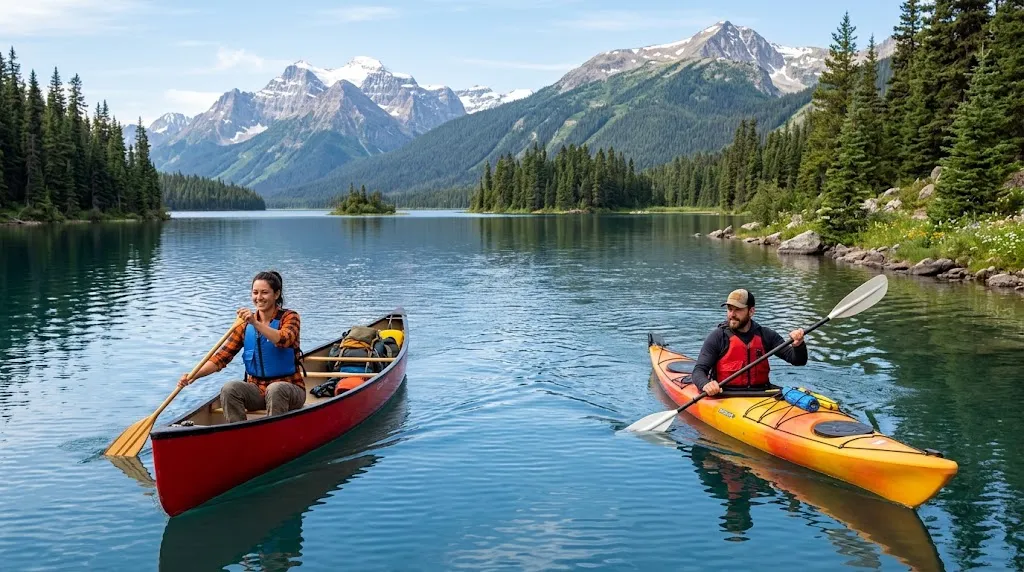
The main difference between a canoe and kayak is their design, seating position, and paddle. Canoes are usually open boats with raised seats and single-bladed paddles, while kayaks generally have lower seating and use double-bladed paddles. The better choice depends on your activity, water conditions, passengers, storage needs, and paddling style.
Key Takeaways
- Canoes are usually open, spacious, and well suited to carrying people and gear.
- Kayaks are generally narrower and use a double-bladed paddle.
- Canoes commonly work well for camping, family trips, and carrying larger loads.
- Kayaks are popular for solo paddling, fishing, touring, and recreational trips.
- Neither is automatically better; the right choice depends on where and how you plan to paddle.
What Is the Difference Between a Canoe and a Kayak?
At first glance, a canoe and kayak can look almost identical. Both are small, human-powered watercraft, and both can be used on lakes, rivers, and other waterways.
The biggest differences become obvious once you get inside—or on top of—the boat.
A traditional canoe is generally an open boat with a higher seating position. Paddlers commonly use a single-bladed paddle. A kayak usually has a lower seating position and is commonly powered with a double-bladed paddle, with a blade at each end.
Kayaks also come in different designs. A sit-in kayak has an enclosed cockpit, while a sit-on-top kayak has an open deck where the paddler sits above the hull.
So, when comparing a canoe vs kayak, it helps to look beyond the names.
Canoe vs Kayak: Side-by-Side Comparison
| Feature | Canoe | Kayak |
| Typical paddle | Single-bladed | Double-bladed |
| Seating | Raised seat or kneeling position | Low seat |
| Deck | Usually open | Sit-in or sit-on-top |
| Storage | Generally spacious | Varies by design |
| Typical use | Camping, family trips, recreation | Touring, fishing, recreation |
| Solo use | Possible, but technique matters | Very common |
| Tandem use | Very common | Available on some models |
| Body position | Higher | Usually lower |
| Getting in/out | Generally open and accessible | Depends on kayak design |
These are general characteristics, not absolute rules. Modern canoe and kayak designs vary significantly according to their intended use.
Canoe vs Kayak for Stability, Speed, and Control
Stability
People often ask whether a canoe or kayak is more stable. There is no single answer because stability depends heavily on hull width, shape, length, seating position, and the specific model.
A recreational canoe can feel stable and roomy, especially on calm water. Many recreational kayaks are also designed with substantial initial stability.
The type of kayak matters, too. Sit-on-top kayaks are often designed with wide, stable platforms, while narrower touring kayaks may prioritize efficiency and directional control.
Speed
A kayak’s double-bladed paddle allows the paddler to alternate strokes quickly from one side to the other. Many kayaks are also relatively narrow and designed to move efficiently through the water.
That does not mean every kayak is faster than every canoe. Hull length, width, paddler skill, wind, current, and load all influence speed.
For long-distance paddling, specialized touring kayaks can be particularly efficient. A recreational canoe may make more sense when carrying people or substantial equipment is a priority.
Control
Kayaks can feel highly responsive because the paddler sits relatively low and uses a double-bladed paddle. The design can make continuous forward strokes convenient.
Canoeing has its own techniques. A skilled canoeist can control direction, maintain a straight course, and maneuver effectively with a single-bladed paddle.
For beginners, the difference often comes down to which paddling technique feels more natural.
Which Is Better for Beginners?
For a first-time paddler, the answer depends on the water, boat design, and personal comfort.
A recreational canoe can be appealing because the open design makes getting in and out straightforward. There is also room for another person, a cooler, camping equipment, or other gear.
A recreational kayak can be appealing because it is often compact and designed for straightforward solo paddling.
If you are considering a kayak, pay attention to whether it is sit-in or sit-on-top. Sit-on-top models provide an open deck and generally make re-entry easier after falling into the water. Sit-in kayaks offer more enclosure and can provide greater protection from cold water and spray, especially when used with appropriate gear.
For beginners, the most important consideration is not simply the boat’s name. Match the craft to your skill level, the water conditions, and the type of trip you actually plan to take.
Canoe vs Kayak for Fishing and Camping
Fishing
Both canoes and kayaks can be useful fishing platforms.
A canoe’s open interior can make it convenient to carry fishing equipment, coolers, tackle, and another person. It can be especially practical for relaxed fishing trips on calm lakes and slow-moving waterways.
Fishing kayaks, particularly sit-on-top models, are also designed around accessibility and open deck space. Some have features such as rod holders, accessory mounting points, and elevated seating.
Your choice should depend on how much equipment you carry and whether you fish alone or with a partner.
Camping
Canoes have long been associated with camping because their open design can accommodate substantial amounts of equipment.
If you’re planning a multi-day trip where you need tents, food, cooking equipment, clothing, and other supplies, cargo capacity becomes an important consideration.
A touring kayak can also carry camping equipment, particularly in dedicated storage compartments, but packing space is typically more limited and requires careful organization.
For a simple day trip, either option may work well.
Canoe vs Kayak for Lakes, Rivers, and Open Water
Where you plan to paddle should influence your decision.
Calm Lakes
Both canoes and recreational kayaks can work well on calm lakes.
A canoe can be convenient for families, couples, and groups carrying gear. A kayak can be convenient for solo exploration, exercise, fishing, or short recreational trips.
Rivers
River conditions vary widely. A slow, calm river is very different from a fast-moving river with rapids.
Some canoes are designed specifically for river travel, while specialized whitewater kayaks are built for maneuverability in rapids.
Do not choose a boat based only on the word “river.” Consider current speed, obstacles, water temperature, weather, and your experience level.
Open Water
For large lakes, coastal areas, or other exposed water, conditions can change quickly.
A sea kayak or touring kayak may be designed for conditions that a recreational boat is not. Similarly, some canoes are built for specific open-water environments.
Pennsylvania’s boating guidance emphasizes choosing a vessel appropriate for the activity and water conditions and checking conditions before paddling.
Canoe vs Kayak for Solo or Tandem Paddling
If you usually paddle alone, a kayak may be a natural option because many kayaks are designed specifically for one paddler.
Canoes can also be paddled solo, but the paddler’s position and canoe design affect handling. Some canoes are specifically designed for solo use.
If you normally go out with a partner, a tandem canoe is a classic choice because it provides an open area for two paddlers and additional equipment.
Tandem kayaks are also available. They can work well for couples, friends, or parents and children, although the experience differs from paddling separate boats.
Think about your usual group before buying.
How to Choose Between a Canoe and Kayak
Ask yourself these questions:
1. Will you paddle alone or with someone else?
Solo paddlers often consider kayaks, while canoes are popular for tandem trips. Both have solo and tandem options.
2. How much equipment will you carry?
If you need lots of camping gear, fishing equipment, or family supplies, an open canoe can provide useful space.
3. What type of water will you use?
Calm lakes, rivers, coastal water, and whitewater can require very different boat designs.
4. Do you want to stay relatively dry?
A sit-in kayak can offer more protection from splashes, while sit-on-top kayaks leave the paddler more exposed.
5. How will you transport and store it?
A boat that is difficult to transport or store may become inconvenient even if it performs well on the water.
6. What activity matters most?
Fishing, camping, touring, casual recreation, and whitewater paddling can all point toward different designs.
Frequently Asked Questions
Is a canoe or kayak easier for beginners?
Neither is automatically easier for everyone. A recreational canoe provides an open, spacious platform, while many recreational kayaks are designed for straightforward solo paddling. A sit-on-top kayak can also make getting back aboard after entering the water relatively simple. Your choice should match your experience and the conditions where you plan to paddle.
Which is better for fishing, a canoe or kayak?
Both can work well. A canoe offers an open interior and room for fishing equipment or another person. A fishing kayak can provide a compact platform with features designed around anglers. Your choice depends on how much gear you carry, whether you fish alone, and the water you use.
Is a canoe more stable than a kayak?
It depends on the specific boat. Stability is affected by hull width, shape, length, seating position, and design. A wide recreational kayak can be very stable, while some narrow canoes are designed for different performance characteristics. Avoid judging stability by the canoe-versus-kayak label alone.
Is a canoe faster than a kayak?
Neither is universally faster. Kayaks often have efficient hull designs and double-bladed paddles, which can make them effective for covering distance. However, speed depends on the boat, paddler, load, wind, current, and water conditions.
Can two people use a kayak?
Yes. Tandem kayaks are designed for two paddlers. However, not every kayak is a tandem, so check the manufacturer’s seating capacity before taking another person aboard.
Conclusion
The canoe vs kayak decision comes down to how you plan to use the boat.
A canoe’s open design, spacious interior, and single-bladed paddle make it a practical option for many family outings, camping trips, and gear-heavy adventures. A kayak’s lower seating position and double-bladed paddle make it popular for solo paddling, touring, fishing, and recreational exploration.
There is no universal winner. The most useful approach is to start with your destination, number of paddlers, equipment, experience, and water conditions, then choose the craft designed for that situation.