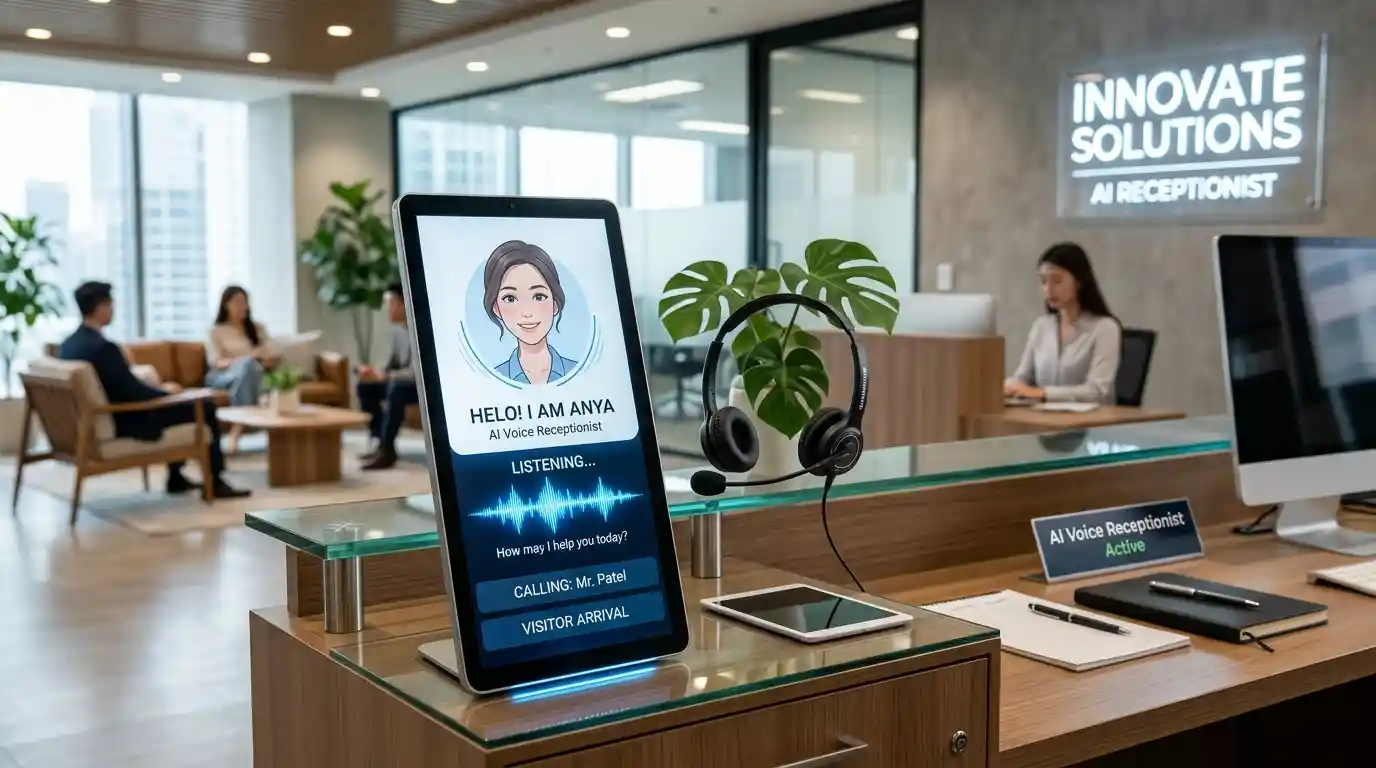
An AI voice receptionist is an automated phone assistant that uses artificial intelligence to answer calls, respond to common questions, collect caller information, schedule appointments, and route calls to the right person. Businesses use it to handle calls around the clock, reduce missed opportunities, and provide faster service without requiring a receptionist to answer every call.
Key Takeaways
- An AI voice receptionist answers incoming calls using conversational AI.
- It can handle FAQs, appointment scheduling, lead capture, and call transfers.
- Small businesses can use it to manage calls after hours and during busy periods.
- Pricing, integrations, voice quality, and call limits vary by provider.
- Human support remains important for complex, sensitive, or urgent conversations.
AI Voice Receptionist
Introduction
An AI voice receptionist helps businesses answer phone calls without requiring a staff member to pick up every time. It uses conversational artificial intelligence to understand callers, respond to common questions, collect contact details, and complete tasks such as scheduling appointments or transferring calls.
Small businesses often explore this technology when they miss calls during busy hours, receive inquiries after closing, or want to improve customer service without hiring additional staff. However, not every AI receptionist offers the same features, and the best option depends on the business’s needs.
In this guide, you’ll learn how an AI voice receptionist works, which tasks it can handle, where it falls short, and what to consider before choosing a service. You’ll also learn how to measure its value and protect customer information.
What Does “AI Voice Receptionist” Mean?
An AI voice receptionist is software that answers phone calls and communicates with callers using a computer-generated voice. It combines speech recognition, language processing, and automated workflows to respond to requests and perform specific tasks.
For example, a caller might ask a plumbing company for an estimate. The receptionist can collect the caller’s name, location, and service needs, then send those details to the business owner.
Businesses use these systems in industries such as home services, real estate, dental offices, salons, law firms, and other appointment-based services. Depending on the provider, the system may also connect with calendars, customer relationship management (CRM) software, and business phone systems.
Salesforce+2
Why Use an AI Voice Receptionist?
A business phone that goes unanswered can mean a lost customer. An AI receptionist can help capture those opportunities while allowing employees to focus on their main responsibilities.
Common benefits include:
- Fewer missed calls: Answer routine inquiries during busy periods, evenings, and weekends.
- Faster responses: Give callers immediate answers to common questions.
- Better lead capture: Collect contact details and information about potential customers.
- Simpler scheduling: Book or change appointments when connected to a compatible calendar.
- Consistent service: Follow approved greetings, business information, and call-handling rules.
- More flexible coverage: Handle multiple calls at once when the provider supports concurrent conversations.
These benefits depend on proper setup and the quality of the service. An AI receptionist cannot guarantee more sales or perfect customer experiences, so businesses should measure actual results.
10 Best Uses and Alternatives to an AI Voice Receptionist
The following are ten practical ways to use an AI voice receptionist, or related solutions, depending on your business needs. They are use cases and service approaches, not ten interchangeable software products.
1. Automated Phone Answering
Meaning: Automated phone answering lets software answer incoming calls and provide information without a staff member handling each interaction. A conversational AI system can go beyond a recorded greeting by responding to callers’ questions.
Best for: Professional, Casual
Example 1: A customer calls a cleaning company to ask whether it serves their neighborhood.
Example 2: Someone contacts a repair shop after closing to ask about its opening hours.
Quick Tip: Start with common questions that have clear, approved answers.
2. Virtual Receptionist Service
Meaning: A virtual receptionist performs front-desk duties remotely rather than sitting at the business location. Depending on the service, it may use AI, human receptionists, or a combination of both.
Best for: Professional, Polite
Example 1: A small consulting firm uses a virtual receptionist to manage calls while its team meets with clients.
Example 2: A property manager relies on remote reception support to direct prospective tenants to the right employee.
Quick Tip: Check whether the service uses AI, human staff, or both before comparing prices.
3. AI Phone Answering Service
Meaning: An AI phone answering service focuses on answering business calls, collecting information, and handling routine requests. It can also send messages or route calls when the appropriate features are available.
Best for: Professional, Friendly
Example 1: A landscaping business collects new customer inquiries while its crew works outdoors.
Example 2: A local retailer uses automated answering to explain holiday hours and store policies.
Quick Tip: Confirm how call summaries reach your team and how quickly staff can return important calls.
4. Automated Appointment Scheduling
Meaning: Automated appointment scheduling allows callers to arrange meetings or service visits through a connected booking system. The receptionist should check real availability instead of guessing which times are open.
Best for: Professional, Polite
Example 1: A salon lets customers schedule haircuts by phone without waiting for an employee.
Example 2: A home inspector accepts appointment requests while traveling between properties.
Quick Tip: Test bookings, cancellations, time zones, and confirmation messages before launch.
5. Intelligent Call Routing
Meaning: Intelligent call routing directs callers to the correct person or department based on their request. An AI receptionist may identify the caller’s purpose and transfer the call according to rules set by the business.
Best for: Professional, Formal
Example 1: A customer asking about an invoice is directed to the billing team.
Example 2: A prospective buyer requesting a property tour is connected to the sales department.
Quick Tip: Always provide a fallback option when the correct department is unavailable.
6. After-Hours Call Management
Meaning: After-hours call management handles calls received outside regular business hours. Depending on its configuration, an AI receptionist can answer questions, collect messages, and identify inquiries that need attention the next business day.
Best for: Friendly, Professional
Example 1: A customer calls a garage door company at 8 p.m. to request a repair appointment.
Example 2: A small accounting firm collects callback requests over the weekend.
Quick Tip: Define which calls can wait and which require immediate human attention.
7. Lead Qualification and Intake
Meaning: Lead qualification involves collecting basic details to help a business understand a potential customer’s needs. An AI receptionist can ask approved questions about the requested service, location, budget, or preferred appointment time.
Best for: Professional, Polite
Example 1: A roofing company gathers a homeowner’s ZIP code and the type of roof damage reported.
Example 2: A real estate office records a buyer’s preferred neighborhood and price range.
Quick Tip: Ask only for information the business genuinely needs, and explain how it will be used.
8. CRM Connected Call Handling
Meaning: CRM-connected call handling sends relevant caller information to a customer relationship management system. When properly integrated, it can help staff review inquiries, follow up with leads, and maintain organized records.
Best for: Professional, Formal
Example 1: A sales representative receives a new lead record after a prospect calls about a service package.
Example 2: A support team reviews a caller’s previous inquiry before returning the call.
Quick Tip: Check that records sync correctly and that access to customer data is restricted.
9. AI and Human Receptionist Support
Meaning: A hybrid receptionist service combines automated call handling with access to human staff. AI manages routine requests, while a person handles complex questions, complaints, or situations that require judgment.
Best for: Professional, Warm
Example 1: An AI answers basic questions before transferring an upset customer to a trained employee.
Example 2: A law office uses automation for initial intake and sends suitable inquiries to its staff for review.
Quick Tip: Test the transfer process, including what happens when no employee answers.
10. Multilingual Phone Assistance
Meaning: Multilingual phone assistance helps businesses communicate with callers in more than one language. Some AI receptionists support multiple languages, but available languages and the quality of conversation vary by provider.
Best for: Friendly, Polite
Example 1: A hotel helps English- and Spanish-speaking guests ask about check-in times.
Example 2: A home services company routes callers to the appropriate language support option.
Quick Tip: Test real conversations in every language you plan to support, including names, addresses, and industry terms.
Comparison Table
| Alternative or use case | Best Used In | Tone |
| Automated phone answering | Routine inquiries | Professional, casual |
| Virtual receptionist service | Front-desk support | Professional, polite |
| AI phone answering service | General call management | Friendly, professional |
| Automated appointment scheduling | Salons and service businesses | Professional, polite |
| Intelligent call routing | Multi-department businesses | Formal, professional |
| After-hours call management | Evening and weekend coverage | Friendly, professional |
| Lead qualification and intake | Sales and service inquiries | Professional, polite |
| CRM-connected call handling | Sales and customer support | Formal, professional |
| AI and human receptionist support | Complex customer service | Warm, professional |
| Multilingual phone assistance | Businesses serving diverse customers | Friendly, polite |
Common Mistakes When Choosing an AI Voice Receptionist
1. Assuming every system offers the same features. Some services only answer questions and take messages, while others can schedule appointments or update a CRM. Verify each feature before subscribing.
2. Ignoring the human handoff. Callers may need help with complaints, unusual requests, or urgent problems. Make sure they can reach a person without getting trapped in an automated conversation.
3. Providing outdated information. Incorrect business hours, prices, or booking availability can frustrate callers. Review the AI’s approved information regularly.
4. Overlooking privacy and consent. Calls may contain personal information or be recorded. Check the provider’s data policies and applicable recording, privacy, and industry-specific requirements before deployment.
5. Judging performance by call volume alone. Answering more calls does not automatically mean better business results. Track completed bookings, qualified leads, missed transfers, caller satisfaction, and total operating costs.
Frequently Asked Questions
1. What is an AI voice receptionist?
An AI voice receptionist is software that answers phone calls using conversational artificial intelligence. It can respond to common questions, collect caller details, schedule appointments, and transfer calls. Its exact abilities depend on the service, integrations, and instructions configured by the business.
2. How does an AI voice receptionist work?
The system processes a caller’s speech, identifies the request, and generates a spoken response. It may then perform an action, such as checking a connected calendar or recording a message. More advanced systems can send call summaries to staff or transfer conversations to a human representative.
3. How much does an AI voice receptionist cost?
Pricing varies by provider, call volume, and included features. Some services charge a monthly subscription, while others bill per call or minute. Additional costs may include setup, phone numbers, integrations, or usage overages. Compare the full expected monthly cost rather than relying on the advertised starting price.
4. Can an AI voice receptionist book appointments?
Yes, some systems can book, reschedule, or cancel appointments when connected to compatible scheduling software. The system must have access to current availability and clear booking rules. Before using it with customers, test confirmations, cancellations, double-booking prevention, and time-zone handling.
5. Is an AI voice receptionist suitable for small businesses?
Yes. Small businesses such as salons, contractors, repair services, and real estate offices may benefit when calls arrive during busy periods or outside business hours. It may be less useful for a business with very few calls or conversations that require frequent human judgment.
6. Can callers tell when they are speaking to AI?
Sometimes. Modern systems can sound natural, but pauses, misunderstandings, and unusual questions may reveal that the caller is speaking with software. Businesses should consider transparent disclosure and should never rely on an AI voice to mislead customers about whether they are speaking with a person.
7. Is an AI voice receptionist secure?
Security depends on the provider, its systems, and your configuration. Review data storage, access controls, encryption, retention periods, and third-party integrations. Businesses handling medical, financial, or other sensitive information should verify applicable legal requirements and any necessary contractual protections before sharing customer data with a vendor.
8. How do I choose the best AI voice receptionist?
Start by identifying your most common calls and the tasks you want to automate. Then compare voice quality, scheduling tools, call routing, language support, integration options, privacy safeguards, pricing, and human escalation. Run a trial using realistic calls before transferring your main business number.
Conclusion
An AI voice receptionist can help a business answer calls, capture new leads, manage appointments, and provide support outside regular business hours. It is especially useful for small businesses that cannot answer every call while serving customers or completing daily work.
The right solution depends on your needs. Choose automated phone answering for routine questions, appointment scheduling for booking based businesses, or CRM-connected call handling when organized follow up matters most. If your customers often need personal attention, look for a service that combines AI with reliable human support.
Before committing, test the system with realistic calls, check its integrations, review privacy practices, and calculate the total cost. Track completed bookings, qualified leads, and customer feedback during a trial.
The best AI voice receptionist is not simply the one that answers the most calls. It is the one that helps callers reach the right outcome without creating extra work for your team.