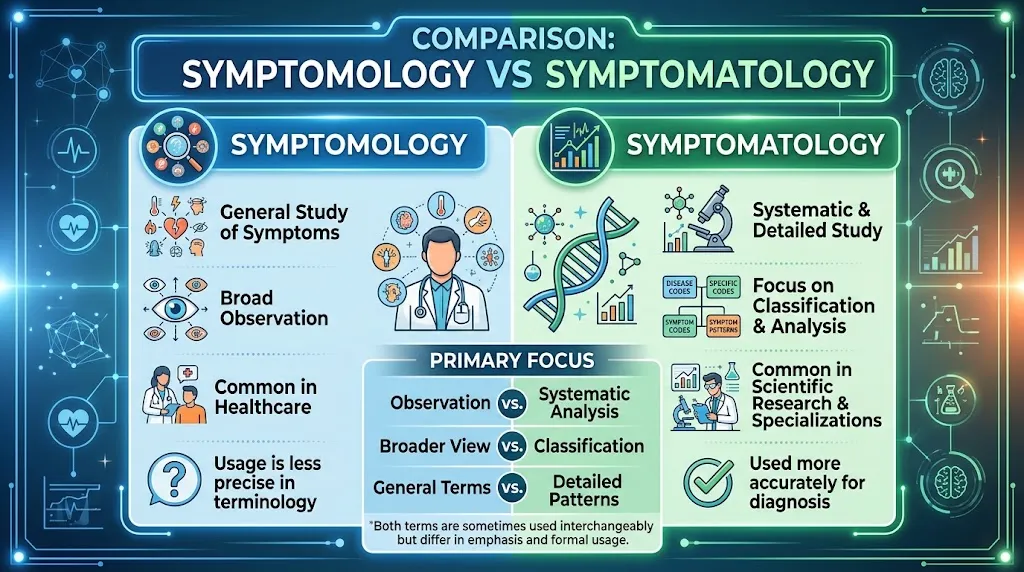
Have you ever typed a medical term into Google and found another word that looks almost exactly the same? That’s what happens with symptomology vs symptomatology. At first glance, both terms seem interchangeable, so it’s easy to wonder whether there is actually a difference. If you’ve seen one in a medical article, textbook, or conversation, you’re not alone in finding the wording confusing.
The good news is that the difference is mostly about usage, terminology, and context, rather than two completely different medical concepts. In this guide, we’ll explain both terms in simple language, compare them side by side, and show which term is generally preferred in medical writing.
Quick Answer: Symptomology and symptomatology both refer to the study or description of symptoms, but symptomatology is the more standard medical term.
🧠 What Does Symptomology vs Symptomatology Mean?
Symptomology and symptomatology are closely related terms used when discussing symptoms associated with a disease, disorder, or medical condition.
Symptomatology is the more widely accepted and established term in medicine. It generally refers to the study, description, or collection of symptoms associated with a particular condition.
For example:
The doctor reviewed the patient’s symptomatology before making a diagnosis.
Symptomology can also be used to describe symptoms or their study, but it is less common in formal medical writing. Some people use it as an alternative to symptomatology, while others consider it less standard.
For example:
The researcher examined the symptomology of the disorder.
The two words are therefore very similar in meaning. The main distinction is that symptomatology is usually the safer and more conventional choice, especially in academic, clinical, and professional contexts.
In short: Symptomology ≈ Symptomatology = the study or description of symptoms.
📱 Where Is Symptomology Commonly Used?
Unlike texting slang, these are medical and academic terms, so you are unlikely to see them used casually on Snapchat or TikTok.
You may encounter them in:
- 🩺 Medical records — descriptions of a patient’s symptoms
- 📚 Medical textbooks — discussions of diseases and disorders
- 🔬 Research papers — studies analyzing symptoms
- 🧠 Psychology and psychiatry — descriptions of mental-health symptoms
- 🏥 Clinical discussions — conversations among healthcare professionals
- 🎓 Academic writing — essays, reports, and medical assignments
- 🌐 Health websites — explanations of symptoms and conditions
Tone: Formal, professional, clinical, or academic.
If you are writing a medical paper or professional report, symptomatology is generally the better choice.
💬 Examples of Symptomology vs Symptomatology in Conversation
Because these words are not normally texting slang, examples are more likely to appear in professional or educational conversations.
Example 1
A: What does this condition usually look like?
B: Its symptomatology can include fatigue, pain, and fever.
Example 2
A: Did the doctor consider all the symptoms?
B: Yes, she reviewed the patient’s symptomatology carefully.
Example 3
A: I’m writing about the disorder for my assignment.
B: You could discuss its typical symptomatology.
Example 4
A: Is symptomology the same as symptomatology?
B: They’re very similar, but symptomatology is more commonly used.
Example 5
A: The study focuses on anxiety symptoms.
B: Right, it examines the symptomatology of anxiety.
Example 6
A: Which word sounds more professional?
B: I’d use symptomatology in a medical paper.
Example 7
A: I saw “symptomology” in an article.
B: That term is used too, but symptomatology is generally the more established choice.
🕓 When to Use and When Not to Use Symptomology vs Symptomatology
✅ When To Use
Use symptomatology when:
- 🩺 Writing a medical or clinical report
- 📚 Completing an academic assignment
- 🔬 Discussing medical research
- 🧠 Describing symptoms of a psychological condition
- 🏥 Talking about a disease’s characteristic symptoms
- ✍️ Writing for a professional healthcare audience
Use symptomology when it appears naturally in your source or field, but consider whether symptomatology would be clearer or more conventional.
❌ When Not To Use
Avoid these technical terms when:
- 💬 Talking casually with friends
- 👨👩👧 Explaining symptoms to someone unfamiliar with medical language
- 📱 Writing a simple social-media post
- 🚨 Giving urgent health instructions where plain language is clearer
- ✉️ Writing a general audience email
For example, instead of saying:
“What is the symptomatology you’re experiencing?”
A healthcare professional speaking plainly might say:
“What symptoms are you experiencing?”
Context Comparison
| Context | Example Phrase | Why It Works |
| Medical paper | “The symptomatology varies between patients.” | Academic & professional |
| Clinical discussion | “The patient’s symptomatology was carefully assessed.” | Medical & precise |
| General conversation | “What symptoms are you having?” | Simple & clear |
| Work chat | “The patient reported several symptoms.” | Professional & understandable |
| “Please describe the symptoms you experienced.” | Formal & accessible |
🔄 Similar Words or Alternatives
| Term | Meaning | When to Use |
| Symptomatology | Study or description of symptoms | Medical and academic writing |
| Symptomology | Study or description of symptoms | Less common alternative |
| Symptoms | Signs or experiences linked to a condition | Everyday and general communication |
| Clinical presentation | How a condition appears in a patient | Medical and clinical contexts |
| Signs and symptoms | Observable signs plus reported symptoms | Healthcare explanations |
| Manifestations | Ways a condition can appear or express itself | Formal medical writing |
The most useful everyday alternative is simply “symptoms.” If your audience is not medically trained, it is usually clearer and easier to understand.
❓ FAQs
1. Are symptomology and symptomatology the same?
They are very similar. Both can refer to the symptoms associated with a disease or condition and their description or study.
2. Which is correct: symptomology or symptomatology?
Symptomatology is generally the more established and preferred term in formal medical and academic contexts.
3. Is symptomology a real word?
Yes. Symptomology is used, although it is less common than symptomatology in many professional contexts.
4. What does symptomatology mean?
Symptomatology refers to the study, description, or pattern of symptoms associated with a disease, disorder, or medical condition.
5. Can I use symptomology in a medical paper?
You can encounter it in medical literature, but symptomatology is usually the safer choice for formal academic writing.
6. Is symptomatology the same as symptoms?
Not exactly. Symptoms are the individual experiences or complaints, while symptomatology refers more broadly to the pattern, description, or study of those symptoms.
7. Which term is more professional?
Symptomatology generally sounds more conventional and established in medical and academic writing.
8. What is an easy word for symptomatology?
A simple alternative is “symptoms” or “symptom pattern,” depending on the sentence.
9. Is symptomatology used in psychology?
Yes. It can be used to describe the collection or pattern of symptoms associated with psychological or psychiatric conditions.
10. Is symptomology informal?
It is not necessarily informal, but it is less standard than symptomatology in many formal medical contexts.
11. Does symptomatology mean diagnosis?
No. Symptomatology describes symptoms; diagnosis is the process of identifying a condition based on available evidence.
12. What is an example of symptomatology?
A group of symptoms such as fatigue, fever, pain, and weakness can form part of a condition’s symptomatology.
13. Can symptomatology describe one symptom?
Usually, the term is more useful when discussing a collection or pattern of symptoms rather than one isolated symptom.
14. Why do people confuse these words?
They have nearly identical meanings and differ mainly in their form and conventional usage.
15. Which word should students use?
For most medical or academic assignments, symptomatology is the better choice unless your instructor or source uses another term.
16. Can doctors use the word symptomatology?
Yes. It is commonly encountered in clinical and medical contexts.
17. Is symptomology incorrect?
It is better described as a less common alternative rather than automatically treating it as incorrect.
18. What’s the difference between symptoms and symptomatology?
Symptoms are individual patient experiences or complaints. Symptomatology refers to the overall description, pattern, or study of symptoms.
19. Is symptomatology a medical term?
Yes. It is primarily used in medical, clinical, psychological, and academic contexts.
20. What should I use in everyday English?
Use “symptoms”. It is simpler, more natural, and easier for most people to understand.
📝 Final Takeaway
When comparing symptomology vs symptomatology, the meanings are extremely close. Both terms can relate to the symptoms associated with a disease or condition. However, symptomatology is generally the more established and preferred term for medical, clinical, and academic writing.
Symptomology is also encountered, but it is less common. For everyday communication, the simplest option is usually just “symptoms.” If you’re writing professionally and want the conventional medical term, symptomatology is usually your best choice.