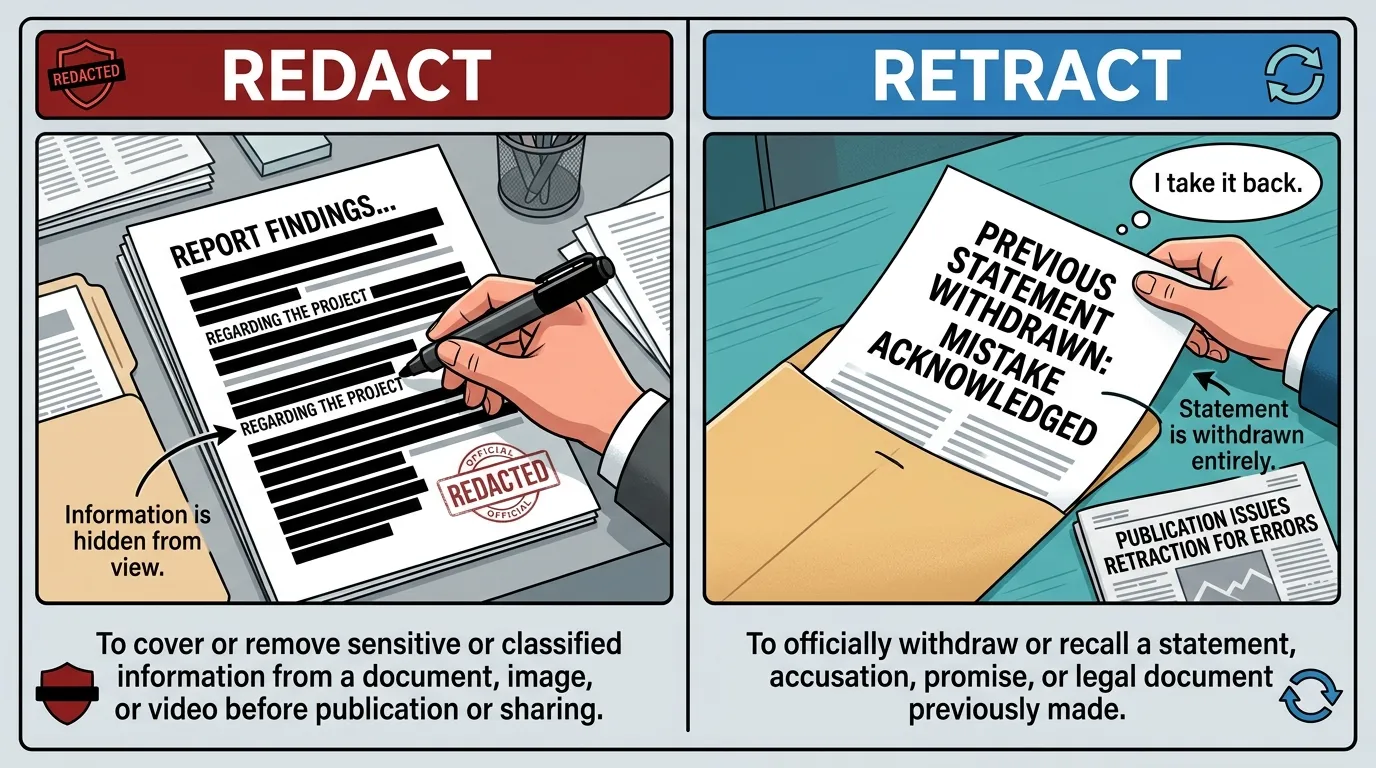
Have you ever seen the words redact and retract and wondered whether they mean the same thing? They look and sound similar, so it is easy to mix them up especially when you are reading emails, news articles, legal documents, or online posts.
I first noticed how confusing these two words can be when someone said they would “retract” part of a statement, while another person talked about “redacting” information from a document. They actually describe two very different actions.
Quick Answer: Redact means to remove or hide sensitive information from a document, while retract means to withdraw or take back something previously said, written, or published. Both are usually formal words, rather than casual texting slang.
🧠 What Does Redact vs Retract Mean?
The easiest way to understand redact vs retract is to remember what happens to the original information.
What Does Redact Mean?
Redact means to edit a document by removing, covering, or hiding certain information. This is commonly done when information is private, confidential, classified, or legally protected.
For example:
The company redacted the customer’s phone number before publishing the report.
The phone number still exists in the original document, but it has been hidden from the public version.
You may see redacted information displayed as black bars, blank spaces, or symbols such as [REDACTED].
What Does Retract Mean?
Retract means to take something back. It can refer to a statement, claim, accusation, article, comment, or published information.
For example:
The newspaper retracted the inaccurate story.
Here, the newspaper is withdrawing its previous claim because it was incorrect or should no longer be considered valid.
In short: Redact = remove or hide information. Retract = withdraw or take back a statement or claim.
📱 Where Are Redact and Retract Commonly Used?
Unlike internet slang, these words are mostly used in formal or informational settings.
🔒 Redact is commonly used in:
- 📄 Legal documents
- 🏛️ Government records
- 🔐 Confidential reports
- 📰 Published documents
- 💼 Business paperwork
- 📧 Emails containing private information
- ⚖️ Court documents
Tone: Formal and professional.
🔄 Retract is commonly used in:
- 📰 News reports
- 📢 Public statements
- 💬 Online discussions
- ⚖️ Legal situations
- 🎤 Interviews
- 📱 Social media posts
- 🧑💼 Professional communication
Tone: Usually formal, although people can use “retract” in everyday conversation.
Neither word is particularly casual, flirty, or typical texting slang. If you are chatting with a friend, simpler words such as hide, remove, take back, or change my statement may sound more natural.
💬 Examples of Redact vs Retract in Conversation
Seeing the words in realistic situations makes the difference much easier to remember.
Example 1
A: Why are some parts of the report blacked out?
B: They redacted the private information before releasing it.
Example 2
A: Did the company really make that claim?
B: Yes, but they later retracted it.
Example 3
A: Can we remove the customer’s address from this file?
B: Sure. We’ll redact it before sending the document.
Example 4
A: I shouldn’t have accused him without proof.
B: Then you should retract the accusation.
Example 5
A: Why does the PDF say [REDACTED]?
B: It means some sensitive information was intentionally hidden.
Example 6
A: The article is still online.
B: The writer may need to retract the false claim.
Example 7
A: Can I retract my email?
B: If your email service supports recall, you may be able to withdraw it.
These examples show the key difference: redaction changes what information is visible, while retraction changes the status of something previously communicated.
🕓 When to Use and When Not to Use Redact or Retract
✅ When To Use “Redact”
Use redact when:
- You are hiding sensitive information.
- A document contains private details.
- Personal information needs to be removed from a public copy.
- Confidential material cannot be shared.
- A legal or government document is being prepared for release.
Example:
“Please redact the employee’s home address from the report.”
❌ When Not To Use “Redact”
Do not use redact when you mean that you are taking back a statement.
Incorrect:
“I redact what I said yesterday.”
Better:
“I retract what I said yesterday.”
✅ When To Use “Retract”
Use retract when:
- You want to withdraw a statement.
- A published claim was incorrect.
- You want to take back an accusation.
- A company withdraws an announcement.
- A newspaper withdraws a story or claim.
Example:
“The magazine retracted the incorrect information.”
❌ When Not To Use “Retract”
Do not use retract when you simply mean hiding information inside a document.
Incorrect:
“Please retract my phone number from the report.”
Better:
“Please redact my phone number from the report.”
Redact vs Retract in Different Contexts
| Context | Example Phrase | Why It Works |
| Legal document | “Redact the witness’s address.” | Private information is being hidden. |
| Work document | “Please redact confidential details.” | Sensitive content is removed from view. |
| News article | “The newspaper retracted the claim.” | A previous claim is being withdrawn. |
| Public statement | “He retracted his accusation.” | He took back what he said. |
| “Please remove the private details.” | More natural for casual communication. |
🔄 Similar Words or Alternatives
| Word | Meaning | When to Use |
| Redact | Hide or remove sensitive information | Documents and confidential records |
| Retract | Take back a statement or claim | Statements, accusations, and publications |
| Remove | Take something away | General everyday situations |
| Delete | Erase something | Files, messages, posts, or text |
| Withdraw | Take back or remove officially | Claims, applications, statements |
| Revise | Change or edit something | Documents, writing, and plans |
A useful memory trick is:
Redact = redact the details.
Retract = retract the statement.
If you are hiding information inside a document, think redact. If you are taking back something you already said or published, think retract.
❓ FAQs
1. What is the main difference between redact and retract?
Redact means hiding or removing sensitive information, while retract means taking back a statement, claim, or publication.
2. Does redact mean delete?
Not always. Redacting usually means hiding information from a particular version of a document rather than permanently destroying the original.
3. Does retract mean delete?
No. Retract usually means officially withdrawing something that was previously said, written, or published.
4. Is redact a formal word?
Yes. Redact is commonly used in legal, government, business, and professional documents.
5. Is retract a formal word?
Yes. Retract is also relatively formal and is common in journalism, law, business, and public statements.
6. Can I use redact in texting?
You can, but it may sound formal. In casual texting, people usually say “hide,” “remove,” or “delete.”
7. Can I use retract in texting?
Yes, but it sounds more formal than “take that back.” It can be used humorously or seriously.
8. What does “redacted” mean?
Redacted means that some information has been hidden or removed from a document.
9. What does “retracted” mean?
Retracted means that someone has withdrawn something they previously said, claimed, or published.
10. What is an example of redaction?
Removing a person’s home address from a public report is an example of redaction.
11. What is an example of retraction?
A newspaper publishing a correction and withdrawing a false claim is an example of retraction.
12. Can a person redact a statement?
Usually, redact applies to information or text that is being hidden. If you want to take back a statement, retract is the better word.
13. Can a newspaper retract an article?
Yes. A newspaper can retract an article, claim, or specific information when it is inaccurate or should no longer be presented as valid.
14. Can you retract an email?
In some email systems, you can recall or retract an email, although the exact feature depends on the email service.
15. Can you redact an email?
Yes. You can redact private or sensitive information before sharing an email or document with someone else.
16. Is “redact vs retract” a grammar question?
It can be considered a vocabulary and word-usage question because the two words have different meanings despite looking similar.
17. Which word means hide information?
Redact means to hide or remove sensitive information from a document.
18. Which word means take back?
Retract means to take back or withdraw something previously said, written, or published.
19. What is an easy way to remember redact vs retract?
Remember: redact = hide details, while retract = take back words.
20. Are redact and retract interchangeable?
No. They describe different actions. Using one instead of the other can change the meaning of your sentence.
Conclusion:
The difference between redact vs retract becomes simple once you focus on the action involved. If information is being hidden from view, use redact. If a statement or claim is being taken back, use retract.
Think of it this way: you redact information, but you retract a statement. That one distinction can help you choose the right word in emails, documents, news stories, social media posts, and everyday conversations.