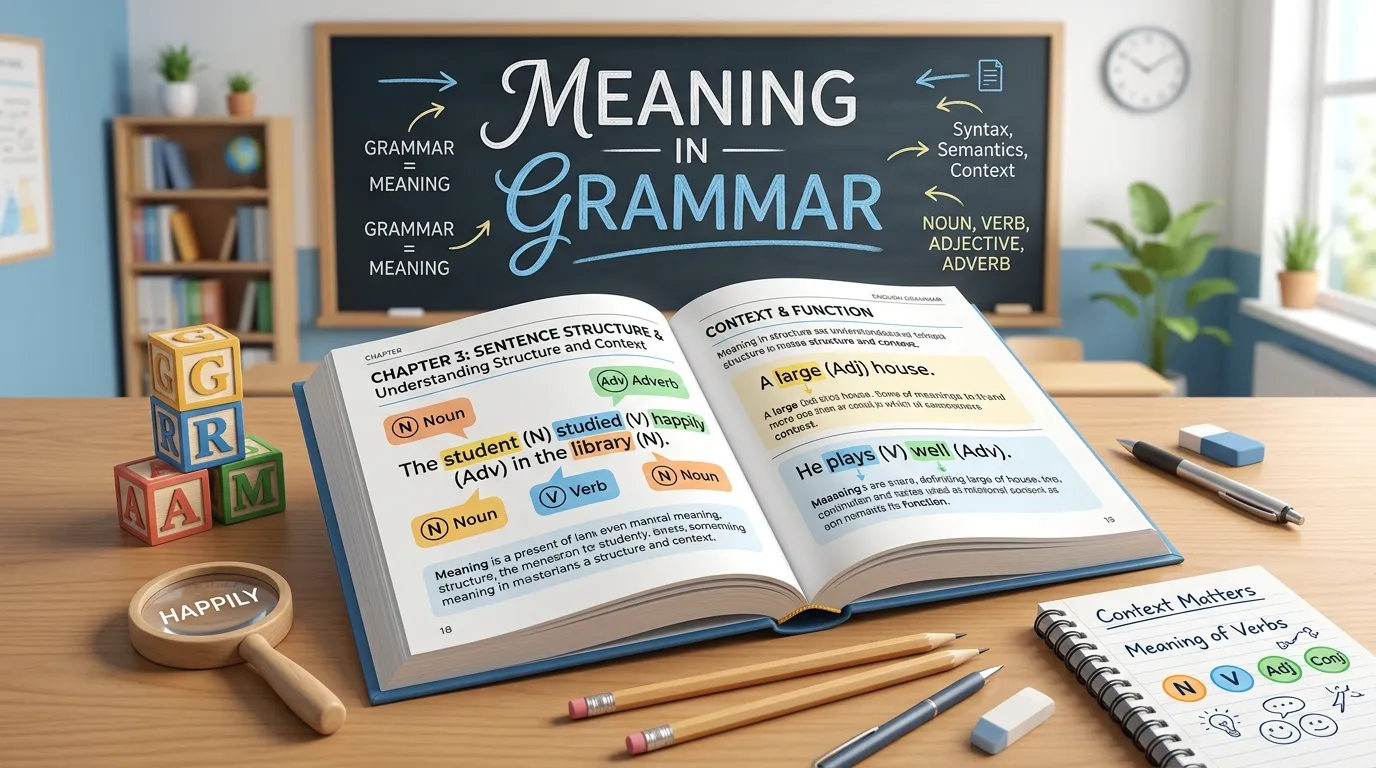
I still remember the day I was reading an English sentence and suddenly stopped because I couldn’t understand what one simple word actually meant in that sentence. I knew the word, but its meaning seemed different from what I had learned before.
That moment made me realize that understanding meaning in grammar is just as important as learning grammar rules. If you’ve ever felt confused while reading, writing, or speaking English, trust me, I’ve been there too.
Instead of memorizing endless rules, I started focusing on how grammar changes the meaning of words and sentences in real conversations. It completely changed the way I understood English. In this guide, I’ll share what I learned in the simplest way possible, so you can clearly understand what meaning in grammar is, why it matters, and how it helps you communicate with confidence every day.
Meaning & Definition
Meaning in grammar refers to the idea, message, or information that grammatical structures communicate. Grammar provides the rules for arranging words, while meaning explains what those words express.
Example:
- The cat chased the mouse.
- The mouse chased the cat.
Both sentences follow correct grammar, but they have completely different meanings because the word order changes.
Meaning in grammar depends on several elements:
- Word order
- Sentence structure
- Verb tense
- Punctuation
- Context
- Pronouns
- Articles
- Prepositions
Consider these examples:
I am eating.
This means the action is happening right now.
I ate.
This means the action happened in the past.
The grammar changes the meaning even though the main verb remains the same.
Grammar also helps express:
- Time
- Possibility
- Certainty
- Questions
- Commands
- Emotions
- Relationships between ideas
Without proper grammar, the intended meaning may become unclear or confusing.
Background
The relationship between grammar and meaning has been studied for centuries. Ancient scholars believed grammar was essential for understanding language correctly. As languages developed, experts realized that grammar was not only about following rules but also about communicating ideas accurately.
Modern linguistics explains that grammar and meaning work together. Grammar provides the structure, while meaning gives purpose to that structure.
Example:
She is reading a book.
The grammar tells us:
- Subject: She
- Verb: is reading
- Object: a book
The meaning tells us that a female person is currently reading.
Different languages use different grammatical systems to express similar meanings. English often depends on word order, while other languages may rely more on verb endings or case markers.
Today, understanding grammatical meaning is important for:
- Education
- Translation
- Writing
- Artificial intelligence
- Language learning
- Professional communication
It helps people communicate ideas more accurately and understand others more effectively.
Usage in Different Contexts
The concept of meaning in grammar appears in many areas of daily life.
Education
Teachers explain grammar so students can understand sentence meaning and write correctly.
Example:
Incorrect:
Running the dog quickly.
Correct:
The dog is running quickly.
The corrected grammar makes the meaning clear.
Literature
Authors use grammar to create different effects.
Short sentences create tension.
Long sentences provide detailed descriptions.
Grammar influences how readers understand a story.
Business Communication
Professional emails rely on grammar for clear meaning.
Example:
Please submit the report by Friday.
This sentence clearly communicates a deadline.
Journalism
News writers depend on accurate grammar to avoid confusing readers.
Even a misplaced comma can change the intended meaning.
Academic Writing
Researchers use grammar carefully so readers interpret facts correctly.
Precise grammar prevents misunderstandings.
Meaning in Chat, WhatsApp, Instagram, and TikTok
In online conversations, grammar often becomes more flexible.
People frequently shorten sentences, ignore punctuation, or use slang.
Example:
- LOL
- BRB
- IMO
- BTW
Although these expressions break traditional grammar rules, their meanings are widely understood.
Example:
“You coming?”
Instead of:
“Are you coming?”
The meaning remains clear because of context.
On WhatsApp and Instagram, people often write:
- Sounds good
- Got it
- No worries
- See you soon
TikTok comments may include:
- That’s wild
- So real
- I’m crying
- This is iconic
The grammar may be informal, but the intended meaning is usually obvious.
Context plays a major role in understanding online messages.
Meaning in Physics, Medical, and Aircraft Terminology
The phrase meaning in grammar itself does not have special definitions in physics, medicine, or aviation. However, grammar is essential in each field because accurate language prevents misunderstandings.
Physics
Scientific writing depends on precise grammar.
Example:
Force equals mass multiplied by acceleration.
Incorrect grammar could change the interpretation of scientific findings.
Medical Field
Doctors must communicate clearly.
Example:
Take one tablet daily.
Poor grammar could create dangerous confusion about medication.
Medical reports also require accurate sentence structure.
Aircraft Terminology
Pilots and air traffic controllers use standardized English grammar.
Example:
Maintain altitude.
Clear grammar improves safety during communication.
Across these professions, grammar supports accurate meaning even though the technical terms themselves belong to their specific fields.
Common Misconceptions
Many people misunderstand the concept of meaning in grammar.
Grammar and meaning are identical.
False.
Grammar organizes language, while meaning communicates ideas.
Correct grammar always guarantees clear meaning.
Not always.
Example:
The chicken is ready to eat.
Does this mean:
- The chicken wants food?
- Will the chicken be eaten?
The grammar is correct, but the meaning is ambiguous.
Informal grammar has no meaning.
False.
Online messages often use incomplete grammar, yet readers easily understand them through context.
Grammar only matters in school.
Incorrect.
Grammar affects work, relationships, business, and everyday communication.
Similar Terms & Alternatives
Several related terms are often confused with meaning in grammar.
| Term | Meaning |
| Semantics | Study of word and sentence meaning |
| Syntax | Rules for arranging words |
| Vocabulary | Collection of words in a language |
| Context | Situation that influences interpretation |
| Sentence structure | Organization of sentence parts |
| Linguistics | Scientific study of language |
| Interpretation | Understanding the intended message |
Each plays a role in understanding language effectively.
How to Respond to It
If someone asks about meaning in grammar, your response depends on the situation.
Simple response:
“It refers to the message or idea that grammar helps express.”
For students:
“Grammar organizes words, while meaning explains what those words communicate.”
For English learners:
“Meaning is what a sentence tells you. Grammar is how the sentence is built.”
When answering online, keep explanations simple and include examples whenever possible.
Differences from Similar Words
Many learners confuse meaning with other language concepts.
| Term | Difference |
| Meaning | The message being communicated |
| Grammar | Rules for building sentences |
| Syntax | Arrangement of words |
| Vocabulary | Individual words themselves |
| Semantics | Study of meanings |
| Definition | Explanation of a word’s meaning |
Example:
Word:
Run
Definition:
Move quickly on foot.
Meaning:
Depends on context.
“I run every morning.”
“I run a business.”
The grammar and context determine the intended meaning.
Relevance in Online Conversations & Dating Apps
Good grammar helps people communicate more clearly online.
On dating apps, grammar can influence first impressions.
Example:
“Would you like to grab coffee sometime?”
This sounds polite and natural.
Compared to:
“Coffee?”
The shorter version may seem casual or unclear depending on context.
Grammar also affects:
- Text messaging
- Online dating
- Social media comments
- Email communication
- Online forums
- Professional networking
Even when people use abbreviations or emojis, grammar still helps organize ideas and avoid confusion.
FAQs
1. What does meaning in grammar mean?
It refers to the idea or message expressed through grammatical structures in a sentence.
2. Is grammar the same as meaning?
No. Grammar provides language rules, while meaning explains what the sentence communicates.
3. Why is meaning important in grammar?
It helps people understand the intended message and prevents misunderstandings.
4. Can grammar change the meaning of a sentence?
Yes. Changes in word order, punctuation, or verb tense can completely alter a sentence’s meaning.
5. Does meaning in grammar apply to social media?
Yes. Even informal online conversations rely on grammar and context to communicate ideas effectively.
Conclusion
Understanding meaning in grammar is essential for clear communication in everyday life. Grammar provides the structure of a sentence, while meaning delivers the message that readers or listeners understand. Together, they help people express ideas accurately in conversations, writing, education, business, and online communication.
If you’re learning English, improving your writing, or simply curious about language, knowing how grammar shapes meaning can make communication more effective and natural. By practicing sentence structure, paying attention to context, and using grammar correctly, you’ll become more confident in expressing your thoughts and understanding others across different situations.