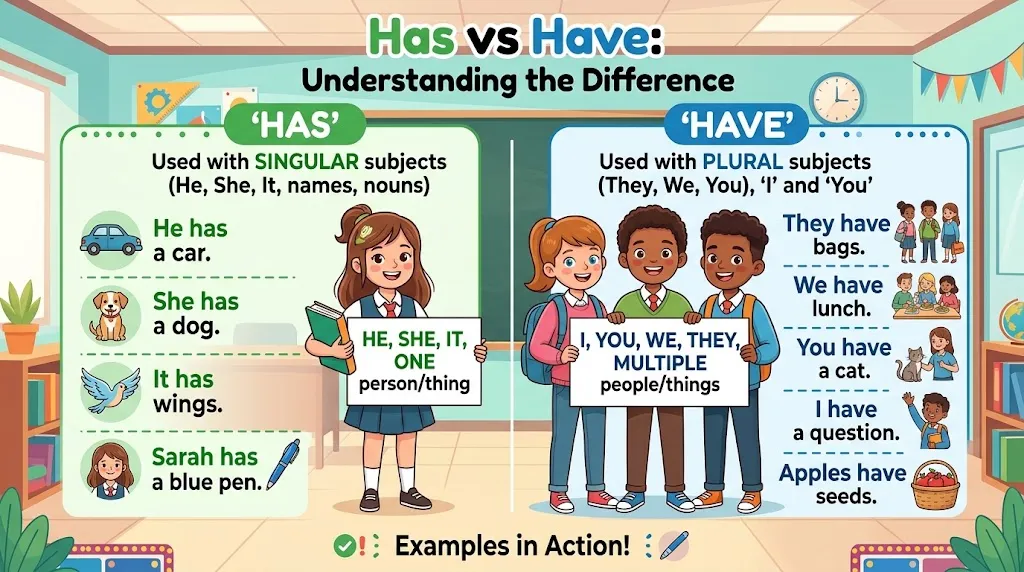
Has and have are two forms of the verb to have. Use has with third-person singular subjects such as he, she, it, and singular nouns. Use have with I, you, we, they, and plural nouns. In questions and negatives with does, use have, not has.
Key Takeaways
- Use has with he, she, it, and singular nouns.
- Use have with I, you, we, they, and plural nouns.
- You always takes have, whether you mean one person or several people.
- After does, doesn’t, did, or modal verbs, use the base form have.
- In the present perfect, use has or have + a past participle.
What Is the Difference Between Has and Have?
The main difference between has and have is subject-verb agreement. Both words come from the verb to have, and both can describe possession, relationships, experiences, or actions.
For example:
- She has a new laptop.
- They have a new laptop.
The meaning of the verb is similar, but the subject changes the form.
The easiest rule is:
He, she, it, or one singular noun → has
I, you, we, they, or plural nouns → have
This basic distinction is also the pattern emphasized across current grammar resources.
The Basic Rule
| Subject | Correct Form | Example |
| I | have | I have a question. |
| You | have | You have a choice. |
| He | has | He has a car. |
| She | has | She has a dog. |
| It | has | It has four legs. |
| We | have | We have enough time. |
| They | have | They have two children. |
Notice something important: I is singular, but it takes have, not has. The same is true for you, whether you are talking to one person or a group.
When to Use Has
Use has with a third-person singular subject in ordinary present-tense statements.
That includes:
- He
- She
- It
- A singular person
- A singular object
- A singular animal
- A singular organization or place
He, She, and It
Examples:
- He has a new job.
- She has a beautiful voice.
- It has a broken handle.
- He has two brothers.
- She has enough experience.
A common mistake is writing “He have” or “She have.” In standard English, those forms are incorrect in ordinary present-tense statements.
Correct:
- He has a meeting.
- She has a question.
Incorrect:
- He have a meeting.
- She have a question.
Singular Nouns and Names
The same rule applies to singular nouns and names.
- Maria has a new phone.
- James has three books.
- The dog has a long tail.
- My car has a flat tire.
- The restaurant has outdoor seating.
A useful trick is to replace the noun with he, she, or it.
For example:
The computer has a problem.
Replace “the computer” with “it”:
It has a problem.
That makes the correct form easier to recognize.
When to Use Have
Use have with:
- I
- You
- We
- They
- Plural nouns
Examples:
- I have a question.
- You have a great idea.
- We have enough food.
- They have two cars.
- The students have homework.
- My friends have tickets.
I, You, We, and They
These pronouns always take have in the present tense.
- I have a plan.
- You have plenty of time.
- We have a meeting tomorrow.
- They have a new house.
One particularly important point is you. Even when “you” refers to only one person, the correct form is still have:
You have a nice smile.
Not:
You has a nice smile.
Plural Nouns
Plural subjects normally take have.
- The boys have new shoes.
- The dogs have plenty of water.
- My parents have a house.
- These books have colorful covers.
- The students have several questions.
Compare:
- The boy has a bicycle.
- The boys have bicycles.
The number of the subject determines the form of the verb.
Has vs Have in Questions and Negative Sentences
This is where many learners become confused.
When do or does is used as the helping verb, the main verb returns to its base form: have.
So we say:
Does she have a car?
Not:
Does she has a car?
Current grammar references consistently identify does + have as the correct structure.
Questions With Does
Compare these sentences:
Statement:
- She has a car.
Question:
- Does she have a car?
Why does “has” change to “have”? Because does already carries the third-person singular marking. The main verb stays in its base form.
More examples:
- Does he have a ticket?
- Does Maria have enough money?
- Does the store have parking?
- Does your brother have a laptop?
Negative Sentences With Does Not
The same rule applies to negative sentences.
- She does not have a car.
- He doesn’t have enough time.
- The store doesn’t have any parking.
- Maria doesn’t have the answer.
Avoid:
- She doesn’t has a car.
- He doesn’t has enough time.
The correct pattern is:
Subject + does not/doesn’t + have
Has vs Have in the Present Perfect
Has and have can also work as helping verbs in the present perfect tense.
The basic structure is:
Subject + has/have + past participle
Use has with third-person singular subjects:
- She has finished her homework.
- He has arrived.
- The movie has started.
- Maria has completed the project.
Use have with I, you, we, they, and plural subjects:
- I have finished my work.
- You have done a great job.
- We have arrived.
- They have completed the project.
Grammar references describe this as another important use of has and have as auxiliary verbs.
Has + Past Participle
Examples:
- He has eaten breakfast.
- She has seen that movie.
- It has changed recently.
- The company has grown quickly.
Have + Past Participle
Examples:
- I have eaten already.
- We have seen that movie.
- You have changed your mind.
- They have finished the work.
Common Mistakes With Has and Have
Here are some mistakes that appear often:
| Incorrect | Correct |
| She have a dog. | She has a dog. |
| They has a car. | They have a car. |
| I has a question. | I have a question. |
| He have two brothers. | He has two brothers. |
| Does she has a phone? | Does she have a phone? |
| He doesn’t has time. | He doesn’t have time. |
The easiest way to avoid these mistakes is to identify the subject first and then check whether another helping verb, such as does, is already present.
Has vs Have Examples
Here are some everyday examples:
Using Has
- My sister has a new job.
- The house has three bedrooms.
- He has a meeting at noon.
- She has a cold.
- The phone has a cracked screen.
Using Have
- I have a meeting today.
- You have a good point.
- We have three options.
- They have a new apartment.
- My friends have similar interests.
Compare the Two
- He has a bike. / They have bikes.
- Sarah has a question. / We have questions.
- The dog has food. / The dogs have food.
- She has finished. / They have finished.
Easy Trick to Remember Has vs Have
If you are unsure, use this simple pattern:
He → has
She → has
It → has
I → have
You → have
We → have
They → have
Then remember one extra rule:
Does → have
For example:
- She has a car.
- Does she have a car?
- She doesn’t have a car.
The word does changes the structure, so you should not put has immediately after it.
Also remember that had is the past form for all subjects:
- I had a car.
- She had a car.
- They had a car.
You do not need to choose between “has” and “have” in the simple past.
Frequently Asked Questions
Is it “he has” or “he have”?
The correct form is “he has.” “He” is a third-person singular subject, so it takes has in an ordinary present-tense statement.
Correct: He has a new phone.
Incorrect: He have a new phone.
Is it “I has” or “I have”?
The correct form is “I have.” Although “I” refers to one person, standard English uses have with “I.”
Example: I have a question.
Is it “does he have” or “does he has”?
The correct form is “Does he have?” After does, use the base form have, not has.
Correct: Does he have a car?
Incorrect: Does he has a car?
Do plural nouns use has or have?
Plural nouns normally use have in the present tense.
For example:
- The students have books.
- My parents have a house.
- The dogs have food.
A singular noun normally uses has:
- The student has a book.
- My parent has a house.
Can “has” and “have” be helping verbs?
Yes. They can function as auxiliary verbs in perfect constructions.
For example:
- She has finished her work.
- They have finished their work.
In these sentences, has and have help form the present perfect tense.
What is the past tense of has and have?
The past tense is had for all subjects.
Examples:
- I had a bicycle.
- He had a bicycle.
- We had a bicycle.
- They had a bicycle.
Conclusion
The difference between has vs have becomes much easier once you focus on the subject.
Use has with he, she, it, and singular nouns. Use have with I, you, we, they, and plural nouns. When does is already doing the grammatical work in a question or negative sentence, use the base form have.
The quick rule to remember is:
He/She/It → has
I/You/We/They → have
With that pattern in mind, most everyday choices between has and have become straightforward.