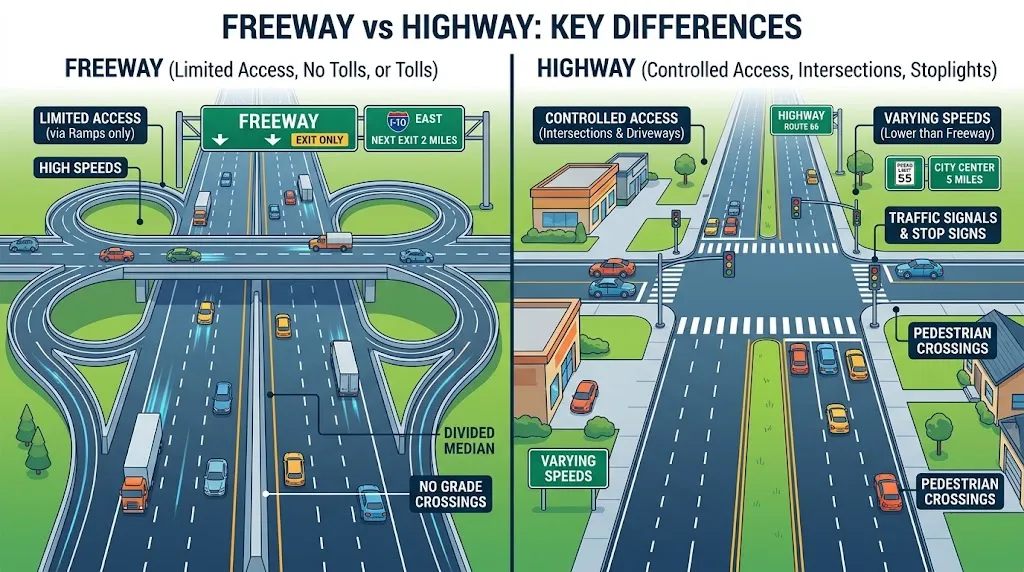
The main difference between a freeway and a highway is access control. A highway is a broad term for a major public road, while a freeway is a type of highway with full control of access. Freeways generally use ramps, have no ordinary intersections or traffic lights, and keep through traffic separated from local access.
Key Takeaways
- Highway is the broader term and can describe many types of major public roads.
- A freeway is a highway designed with full control of access.
- Freeways normally use entrance and exit ramps instead of direct driveway or intersection access.
- Freeways generally eliminate at-grade intersections and traffic signals.
- A freeway can still be a toll road; “freeway” refers to access design, not necessarily whether drivers pay a toll.
What Is a Highway?
A highway is a general term for a public road used for vehicle travel. In everyday American English, people often use “highway” for an important road that connects cities, towns, suburbs, or regions.
The important point is that highway is a broad category. A highway does not automatically have all the features of a freeway.
For example, a highway may have:
- One or more lanes in each direction
- Intersections with other roads
- Traffic lights
- Direct access to businesses
- Driveways
- Side streets
- At-grade railroad crossings
- Different speed limits along its route
The exact legal definition can vary depending on the context and jurisdiction. Federal regulations, for example, define a highway broadly as a public way for vehicular travel.
So when someone says, “Take the highway,” they may simply mean a major road. They are not necessarily saying that the road is a freeway.
What Is a Freeway?
A freeway is a more specific type of roadway.
The Federal Highway Administration describes a freeway as a divided highway with full control of access. Some federal transportation definitions further describe freeways as facilities designed for through traffic, with access provided at selected locations.
In practical terms, this means drivers generally cannot enter a freeway wherever they want.
Instead, they use designated:
- Entrance ramps
- Exit ramps
- Interchanges
- Overpasses
- Underpasses
A typical freeway does not have ordinary traffic lights or intersections where vehicles cross directly through the main travel lanes.
This design helps separate local traffic from vehicles traveling longer distances.
What Does “Free” Mean in Freeway?
One common misunderstanding is that freeway means a road that is free of charge.
That is not necessarily true.
The Federal Highway Administration explains that “freeway” refers to how motorists enter and leave the highway, rather than how the road is financed. A toll facility can still have freeway characteristics.
In other words:
Freeway = freedom from ordinary access points and intersections, not necessarily freedom from tolls.
Freeway vs Highway: Key Differences
The easiest way to understand freeway vs highway is to look at access.
| Feature | Highway | Freeway |
| Meaning | Broad term for a public road | Specific type of highway |
| Access | May be open or controlled | Fully controlled |
| Traffic lights | May have them | Normally none on the main roadway |
| Regular intersections | May have them | Generally eliminated |
| Driveway access | May be possible | Normally prohibited |
| Entrance/exit ramps | May or may not use them | Standard feature |
| Grade separation | May or may not exist | Commonly required |
| Opposing traffic | May or may not be separated | Divided roadway |
| Tolls | May or may not apply | May or may not apply |
| Through traffic | Varies | Major priority |
The Federal Highway Administration’s terminology is especially useful here: a freeway is distinguished by full control of access, while an expressway has partial control of access.
Access Is the Biggest Difference
Imagine two roads that are both wide and busy.
Road A has six lanes, but drivers can turn directly into a shopping center, cross at traffic lights, and enter from several side streets.
Road B also has six lanes, but drivers can enter only through ramps. Side roads pass over or under the main roadway, and businesses cannot have direct driveways onto the main lanes.
Road B fits the technical idea of a freeway much more closely.
So, the number of lanes alone does not determine whether a road is a freeway.
Access control is more important than simply how large or fast the road looks.
Are Freeways Highways?
Yes, in the broad sense, a freeway is a type of highway.
Think of the relationship this way:
Highway → broad category
Freeway → specific type of highway
That means the statement “all freeways are highways” is generally useful, while “all highways are freeways” is not correct.
A highway can have intersections and direct property access. A freeway is designed to prevent those ordinary access points from interfering with through traffic.
This distinction is also reflected in federal transportation terminology.
Does a Freeway Have to Be Toll-Free?
No.
This is one of the most common misconceptions about the word freeway.
A toll road can have the characteristics of a freeway. The term describes the roadway’s access arrangement rather than whether drivers pay money to use it. The FHWA specifically notes that tollways and toll roads can be treated as freeways when they function as limited-access facilities.
So these statements are not necessarily equivalent:
- Freeway = free road
- Toll road = not a freeway
A road can be both tolled and access-controlled.
Freeway vs Interstate vs Expressway
These three terms are related, but they do not mean exactly the same thing.
Freeway
A freeway describes a roadway design and access characteristic. Full control of access is the key feature.
Interstate
An Interstate refers to the U.S. Interstate Highway System, a nationwide network of designated routes.
An Interstate highway is commonly built to freeway standards, but the terms describe different concepts.
“Interstate” tells you about the route’s classification within the national system.
“Freeway” tells you about the roadway’s access design.
Expressway
An expressway is similar to a freeway but may have partial control of access rather than full control. FHWA terminology distinguishes a freeway from an expressway in this way.
This is why simply calling every fast, divided road a freeway can sometimes be technically inaccurate.
Why Do Americans Use Different Road Terms?
Road terminology can vary across the United States.
In everyday conversation, people may use highway, freeway, expressway, interstate, route, or turnpike differently depending on where they live and what road they are describing.
There is also a difference between technical transportation terminology and casual speech.
For example, someone may call a major controlled-access road a “highway” even when transportation professionals would describe it more specifically as a freeway.
Dictionary definitions also reflect this overlap. “Highway” is generally broader, while “freeway” can refer specifically to an express highway with controlled access.
So if you hear Americans use the words interchangeably, that does not necessarily mean the technical distinction does not exist.
Examples of Freeways and Highways
Consider these simple examples.
Example 1: Controlled-access freeway
You enter through an on-ramp, merge into traffic, continue for 20 miles, and leave through an exit ramp.
You do not encounter regular traffic lights or stop signs on the main roadway.
That is characteristic of a freeway.
Example 2: Major highway with intersections
You drive on a large road connecting two cities. Along the way, you pass gas stations, restaurants, traffic lights, side streets, and business entrances.
It may be called a highway, but those features mean it does not necessarily meet the full-access-control definition of a freeway.
Example 3: Interstate freeway
You travel on an Interstate route where access is provided through interchanges and ramps.
It can be both:
Interstate + freeway + highway
These labels are describing different aspects of the road.
Common Mistakes About Freeways and Highways
Mistake 1: “Every highway is a freeway.”
Not true. Highway is the broader term.
Mistake 2: “Freeway means free to use.”
Not necessarily. A freeway can be tolled.
Mistake 3: “A road needs six or eight lanes to be a freeway.”
Lane count alone does not determine the classification. Access control is a central feature of the definition.
Mistake 4: “Interstate and freeway mean exactly the same thing.”
They are related but describe different concepts. Interstate refers to a designated national highway system, while freeway describes a type of access-controlled roadway.
Mistake 5: “Every expressway is a freeway.”
Not necessarily. Under FHWA terminology, an expressway has partial control of access, while a freeway has full control.
FAQs:
What is the main difference between a freeway and a highway?
The main difference is access control. Highway is a broad term for a public roadway, while a freeway is a highway with full control of access. Freeways generally use ramps and grade-separated crossings instead of ordinary intersections and direct property access.
Is a freeway the same as an interstate?
No. The terms overlap but describe different things. An Interstate is part of the U.S. Interstate Highway System, while a freeway is a roadway with full access control. Many Interstate routes are freeways, but “Interstate” and “freeway” are not synonyms.
Why is it called a freeway?
The term “freeway” was developed to describe a roadway designed for freer movement of traffic, without ordinary intersections and private access points disrupting the flow. FHWA’s historical material credits urban planner Edward M. Bassett with coining the term in the early 20th century.
Can a freeway have a toll?
Yes. “Freeway” describes access characteristics, not whether the driver pays a toll. A toll facility can still operate as a controlled-access freeway.
Are highways always divided roads?
No. The word highway is broad and does not automatically mean a divided, multi-lane road. Some highways can have different designs, including roads with opposing traffic traveling on the same roadway.
Is an expressway the same as a freeway?
Not always. Under FHWA terminology, a freeway has full control of access, while an expressway has partial control of access.
Conclusion:
If you remember only one thing, remember this:
A highway is the broader category, while a freeway is a specific type of highway designed for controlled access.
A highway may have intersections, traffic lights, driveways, and direct access to businesses. A freeway normally keeps through traffic separate from those local access points by using ramps, interchanges, overpasses, and underpasses.
That is why a freeway can also be called a highway, but not every highway should technically be called a freeway.
The exact terminology can vary in everyday American speech, but when discussing roadway design, full control of access is the key distinction.