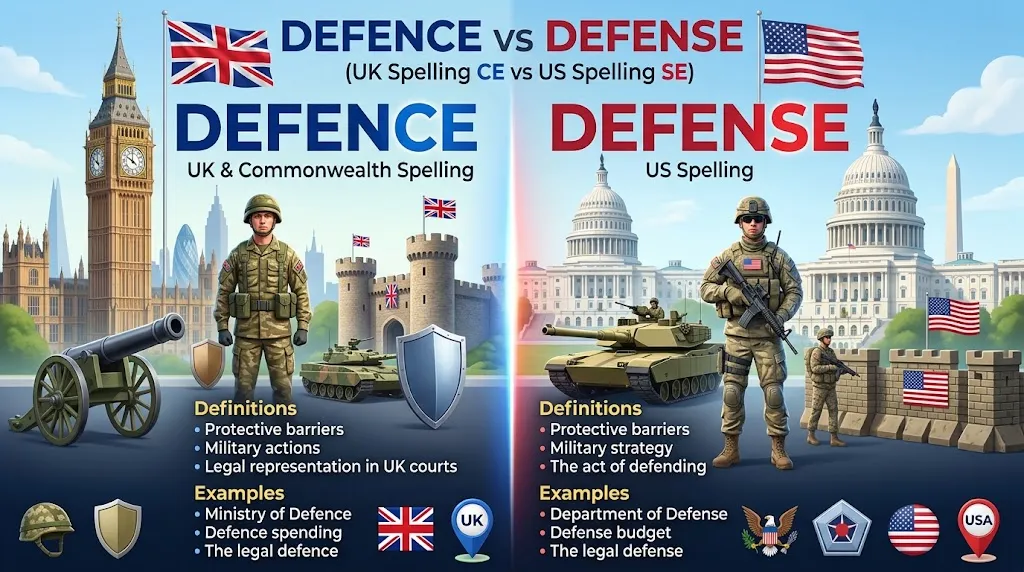
Defense is the standard spelling in American English, while defence is the standard spelling in British English. Both words have the same basic meaning: protection against attack, harm, criticism, or accusation. They are generally pronounced the same way, so the difference is mainly a matter of regional spelling.
Key Takeaways
- Defense is the preferred spelling in American English.
- Defence is the preferred spelling in British English.
- Both spellings have the same core meanings.
- Both are normally pronounced /dɪˈfens/.
- Use one spelling consistently throughout your writing.
- Related words such as defensive and defensible are spelled with s in both varieties.
Defence vs Defense: The Quick Answer
If you searched defence vs defense, you are probably wondering whether these are two different words or simply two spellings.
The answer is simple: they are spelling variants of the same word.
| American English | British English |
| defense | defence |
| self-defense | self-defence |
| national defense | national defence |
| defense policy | defence policy |
| defense attorney | defence lawyer |
| defense system | defence system |
Oxford and Cambridge both identify defense as the U.S. form and defence as the British form.
So if you are writing for readers in the United States, defense is the spelling you normally want.
What Does Defense Mean?
Defense is a noun that can refer to protecting someone or something from attack, harm, criticism, or danger.
It can also describe an argument used to support a person, idea, or position. In law, it refers to the case or argument presented on behalf of someone accused of wrongdoing. In sports, it can describe the players or strategy used to prevent an opponent from scoring.
For example:
- The city built a strong defense against flooding.
- She spoke in defense of her friend.
- The lawyer prepared a strong defense.
- The team needs to improve its defense.
The meaning changes slightly depending on context, but the spelling defense remains standard in American English.
What Does Defence Mean?
Defence has the same basic meanings as defense, but it is the traditional British English spelling.
You may see it in British writing about government, law, sports, personal protection, or general arguments.
Examples include:
- The country strengthened its defence system.
- She came to her friend’s defence.
- The lawyer prepared the defendant’s defence.
- The team has a strong defence.
Cambridge lists defence as the UK spelling of the U.S. word defense.
This means that defence is not a different concept. It is simply the spelling normally used in British English.
Defense vs Defence in American and British English
The easiest way to remember the distinction is to connect the spelling with the English variety.
| English variety | Standard spelling |
| American English | defense |
| British English | defence |
For a U.S.-focused website, article, essay, business document, or school assignment, use defense.
For British English, use defence.
This regional difference is similar to other spelling pairs, such as:
- color / colour
- center / centre
- offense / offence
- theater / theatre
However, these spelling patterns have their own histories, so it is better to learn each common word rather than assume every English word follows one simple rule.
Defense vs Defence in Different Contexts
The spelling difference remains the same even when the meaning changes according to context.
Military and National Security
In military writing, defense is the standard American spelling.
Common American expressions include:
- national defense
- defense policy
- defense spending
- air defense
- missile defense
- defense systems
- defense forces
The official name of the U.S. federal department is the Department of Defense, which uses the American spelling. The U.S. Department of Defense itself uses “Defense” throughout its official website.
British English uses forms such as:
- national defence
- defence policy
- defence spending
- air defence
- missile defence
Oxford specifically gives Department of Defense as the U.S. form and Ministry of Defence as the British form.
Legal Writing
Both spellings are also used in legal contexts.
American English:
The defense attorney presented new evidence.
British English:
The defence lawyer presented new evidence.
In both cases, the word refers to the legal side or argument presented in response to an accusation.
Oxford defines the legal sense as what is said in court to show that a person did not commit a crime.
So if you are writing for a U.S. legal audience, use defense.
Sports
Sports provide another common example.
American English commonly uses:
- defense
- play defense
- defensive player
- defense line
For example:
The team’s defense stopped the opponent from scoring.
British English commonly uses defence:
The team’s defence stopped the opponent from scoring.
Oxford lists defense for North American usage and defence for British usage in sports.
Everyday and General Writing
The word can also describe protection or support in everyday writing.
American:
She came to her friend’s defense.
British:
She came to her friend’s defence.
The meaning stays the same. Only the regional spelling changes.
Self-Defense vs Self-Defence
One of the most common variations is self-defense versus self-defence.
For American English:
self-defense
For British English:
self-defence
Examples:
- He claimed he acted in self-defense.
- The course teaches basic self-defense techniques.
In British writing:
- He claimed he acted in self-defence.
- The course teaches basic self-defence techniques.
If your content targets the United States, self-defense is the appropriate spelling.
Why Are Defense and Defence Spelled Differently?
The difference comes from the development of English spelling over time.
Oxford traces the word through Middle English and Old French, ultimately connecting it to the Latin defendere, meaning “to defend.” Over time, different spelling conventions developed in British and American English.
British English retained the traditional -ce spelling:
defence
American English standardized the -se spelling:
defense
This is why you may encounter both forms in books, websites, newspapers, academic writing, and international publications.
The important point is that the spelling difference does not normally represent a difference in meaning.
What About Defensive and Defensible?
This is an important detail because writers sometimes assume that every related word should change from s to c in British English.
That is not correct.
The standard spelling is:
- defensive
- defensible
- defensively
These forms use s in both American and British English.
For example:
American: The player used a defensive strategy.
British: The player used a defensive strategy.
You should not write defencive in standard English.
This makes the noun pair slightly different from what a simple “change s to c” rule might suggest.
Common Mistakes to Avoid
Mistake 1: Thinking the words have different meanings
They generally do not.
Defense and defence are regional spelling variants.
Mistake 2: Using defence in U.S.-focused writing
If your audience is American, use:
defense
For example:
The company developed a new defense system.
Mistake 3: Assuming defense is the only correct form everywhere
Defense is standard American English, but defence is standard British English.
The spelling depends on the variety of English being used.
Mistake 4: Writing “defencive”
The correct adjective is:
defensive
This spelling is used in both American and British English.
Mistake 5: Mixing spelling systems
Try to keep your spelling consistent.
For example, a U.S.-focused article would normally use:
- color
- center
- traveled
- defense
A British-focused article would normally use:
- colour
- centre
- travelled
- defence
Consistency helps readers understand which English variety you are following.
Defense vs Defence Examples
Here are some simple examples side by side:
| American English | British English |
| The team has a strong defense. | The team has a strong defence. |
| He acted in self-defense. | He acted in self-defence. |
| She came to my defense. | She came to my defence. |
| The country increased its defense spending. | The country increased its defence spending. |
| The lawyer prepared a defense. | The lawyer prepared a defence. |
| The city needs better flood defenses. | The city needs better flood defences. |
| The government announced a new defense policy. | The government announced a new defence policy. |
| The players worked on their defense. | The players worked on their defence. |
The important thing to notice is that the sentence meaning does not change.
Which Spelling Should You Use?
Choose the spelling based on your audience and the style of English you are using.
| If you are writing for… | Use |
| United States | defense |
| American English | defense |
| U.S. academic writing | defense |
| U.S. business writing | defense |
| U.S. legal writing | defense |
| U.S. sports writing | defense |
| United Kingdom | defence |
| British English | defence |
| British academic writing | defence |
| British sports writing | defence |
Because the target audience for this article is the United States, defense should be your default choice.
There is one important exception: official names should be preserved. For example, the official U.S. government name is Department of Defense, not “Department of Defence.”
FAQs :
Is defense the American spelling?
Yes. Defense is the standard American English spelling. Major dictionaries, including Cambridge and Oxford, identify defense as the U.S. form of defence.
Is defence the British spelling?
Yes. Defence is the standard British English spelling. It is used in British writing for the same major meanings covered by the American spelling defense.
Are defense and defence the same word?
Yes. They are regional spelling variants of the same word. Both can refer to protection, legal arguments, support for an idea, military protection, or defensive play in sports.
Is “defence” wrong in American English?
It is not the standard U.S. spelling. American English normally uses defense. However, defence may appear in an American text when quoting British material or discussing British usage.
Is “defense” wrong in British English?
It is not the standard British spelling. British English normally uses defence. The American spelling can still appear when referring to American sources, names, or quotations.
Do defense and defence have the same pronunciation?
Yes. Both are normally pronounced /dɪˈfens/. The spelling changes by region, but the usual pronunciation does not.
Which is correct: “in defense of” or “in defence of”?
Both are correct. Use in defense of in American English and in defence of in British English.
Which is correct: self-defense or self-defence?
Both are correct depending on the English variety. Self-defense is American English, while self-defence is British English.
Is “defensive” spelled differently in British English?
No. Defensive is the standard spelling in both American and British English. Do not write “defencive.”
Which is correct in sports: defense or defence?
Both are correct in their respective varieties. American English generally uses defense, while British English generally uses defence.
Which is correct in legal writing?
Both are correct depending on the variety of English. U.S. legal writing uses defense, while British legal writing uses defence.
Does defense have a different meaning from defence?
No. The spelling difference normally does not create a different meaning. The two forms represent the same word in different English spelling traditions.
Conclusion:
The difference between defence vs defense is mainly a matter of regional spelling.
Defense is the standard spelling in American English.
Defence is the standard spelling in British English.
Both forms can refer to protection against attack or harm, a legal argument, support for a person or idea, military protection, or defensive play in sports. Their normal pronunciation is also the same.
For a U.S. audience, choose defense:
national defense
self-defense
defense attorney
defense policy
defense system
For a British audience, choose defence:
national defence
self-defence
defence lawyer
defence policy
defence system
The simplest rule is:
American English → defense
British English → defence
Once you know which English variety your audience expects, the choice becomes straightforward. The most important thing is to use the appropriate spelling consistently throughout your writing.