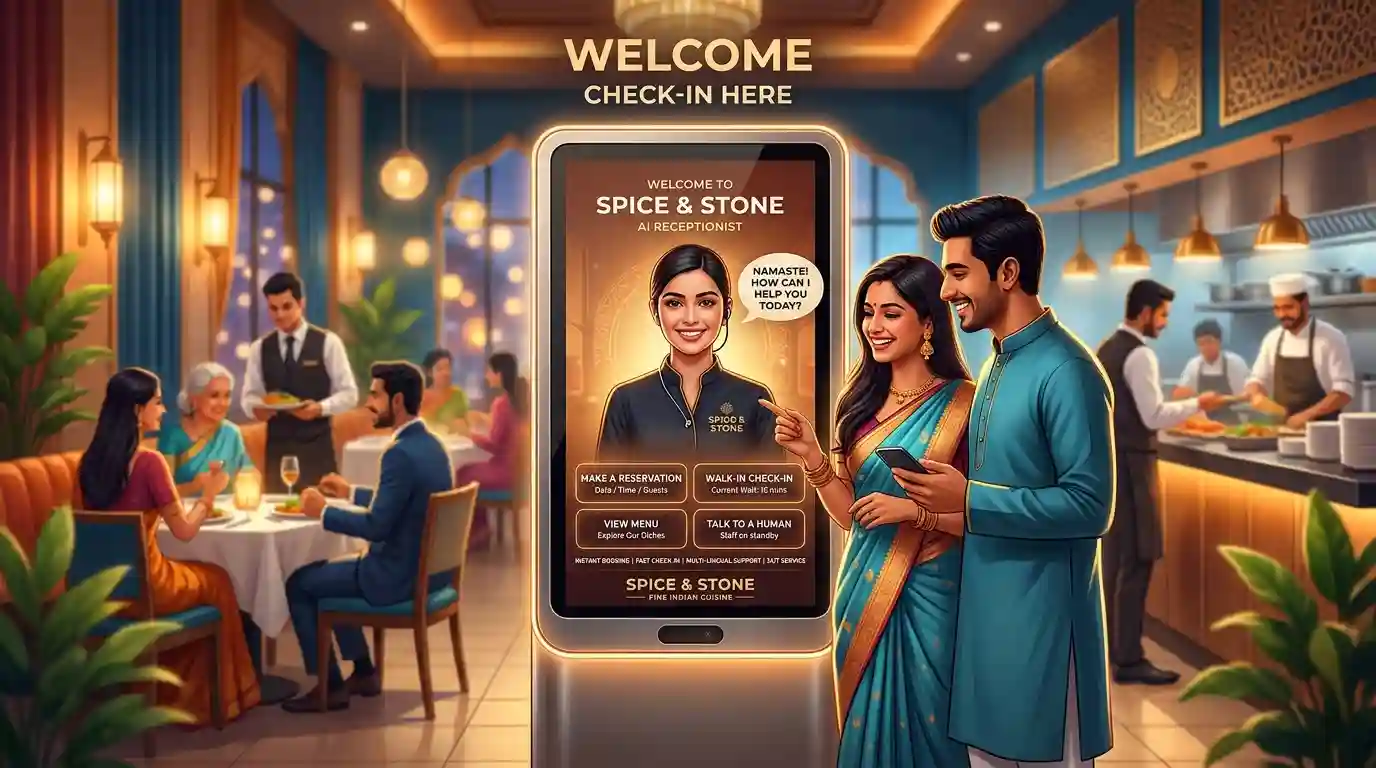
An AI receptionist for restaurants is a virtual phone assistant that answers customer calls, responds to common questions, helps manage reservations, and may take food orders. It works around the clock, reduces missed calls, and gives restaurant employees more time to serve customers. Some systems also connect with POS and reservation platforms.
Key Takeaways
- An AI receptionist answers restaurant calls without requiring a staff member to pick up.
- It can handle reservations, menu questions, business hours, directions, and takeout orders.
- POS and reservation integrations determine how much work the AI can complete.
- Pricing depends on call volume, features, locations, and integrations.
- Human support remains important for complaints, special requests, and complex situations.
Introduction
Running a restaurant means handling several tasks at once. Employees greet guests, prepare orders, manage reservations, and answer questions while trying to keep service moving. When the phone rings during a busy dinner shift, someone may not have time to answer it.
An AI receptionist for restaurants helps solve this problem by answering incoming calls and handling common customer requests. Instead of leaving callers on hold or sending them to voicemail, restaurants can use voice AI to provide quick responses and capture important information.
These systems can do more than answer basic questions. Depending on the software, they may book tables, take pickup orders, send text messages, and connect with restaurant management tools. This guide explains how they work, what features matter, how much they cost, and how to choose the right solution for your business.
What Is an AI Receptionist for Restaurants?
An AI receptionist for restaurants is an automated voice assistant that communicates with customers over the phone. It uses artificial intelligence and speech recognition to understand questions and respond in natural language.
For example, a customer might call and ask, “Are you open on Sunday?” The assistant checks the restaurant’s saved business information and provides an answer without involving an employee.
Restaurants commonly use this technology for:
- Answering incoming phone calls.
- Sharing menus, prices, and opening hours.
- Handling table reservation requests.
- Taking pickup and delivery orders.
- Providing directions and parking information.
- Sending order or reservation confirmations.
- Transferring complicated calls to employees.
However, not every AI receptionist offers all these services. Some only answer questions and collect messages, while restaurant-specific systems can complete transactions through supported software integrations.
Why Are Restaurants Using AI Receptionists?
Restaurants receive calls from customers who want quick answers. Missing those calls can mean losing reservations, takeout orders, and potential customers.
An AI receptionist helps businesses manage these conversations without adding another person to the front desk.
Here are some important benefits:
- Fewer missed calls: The system can answer multiple incoming calls, depending on its capacity.
- 24/7 availability: Customers can get basic information outside regular business hours.
- Less pressure on employees: Staff can focus on guests inside the restaurant.
- Faster customer responses: Callers do not always need to wait for an available employee.
- Consistent information: The assistant can use approved menu details, policies, and business hours.
- Better call management: Restaurants can collect customer details and route important requests.
The biggest benefit is not replacing hospitality. It is giving restaurant employees more time to provide personal service where it matters most.
Essential Features of a Restaurant AI Receptionist
Before choosing software, understand which features can make a real difference to your restaurant.
1. 24/7 Call Answering
A restaurant AI receptionist can answer calls during lunch, dinner, closing hours, and busy weekends. It can share basic information even when employees are unavailable.
This feature is particularly useful for restaurants that receive calls outside normal business hours.
2. Automated Table Reservations
Some systems can check availability, book tables, and update existing reservations. They may connect with platforms such as OpenTable and Resy.
For example, a customer can request a table for four at 7 p.m. The AI checks the connected reservation system and confirms the booking if a suitable table is available.
3. Phone Order Taking
Restaurant-focused AI assistants can take food orders over the phone. More advanced systems understand menu items, toppings, portion sizes, special instructions, and order modifications.
Some can send completed orders directly to a POS system such as Toast or Square. Always confirm that your chosen plan supports your specific POS setup.
4. Menu and Business Information
Customers often call to ask about:
- Opening and closing times.
- Menu items and prices.
- Vegetarian and vegan options.
- Delivery and pickup availability.
- Restaurant location and parking.
- Catering and private events.
An AI receptionist can answer these questions using information supplied by the restaurant. Owners should regularly update this information to avoid incorrect answers.
5. Call Transfers and Human Support
AI cannot handle every conversation perfectly. Customers may have complaints, allergy concerns, refund requests, or unusual booking needs.
A good system should recognize when a request needs human attention and transfer the call to an available employee or manager.
6. Multiple Language Support
Restaurants serving diverse communities may receive calls in different languages. Some AI receptionists support multilingual conversations, helping customers communicate more comfortably.
Check which languages and accents the software actually supports before purchasing.
How Does an AI Receptionist Work?
Most restaurant AI receptionists follow a simple process:
- Customer calls: A guest dials the restaurant’s existing number or a connected business number.
- AI answers: The virtual receptionist greets the caller using a customized message.
- Request identification: Speech recognition helps the system understand what the customer needs.
- Information retrieval: The assistant checks its restaurant knowledge base or connected software.
- Request completion: It answers questions, records details, or completes supported bookings and orders.
- Confirmation: The customer receives verbal confirmation or a text message when available.
For example, someone calling a pizza restaurant might say, “I’d like a large pepperoni pizza for pickup.”
The AI can collect the order details, confirm the price, and send the ticket to the POS if the integration supports that process.
How Much Does an AI Receptionist for Restaurants Cost?
The cost depends on the provider, number of locations, monthly calls, included minutes, and available features.
Some providers charge a flat monthly fee, while others use per-call, per-minute, or custom enterprise pricing.
Here are examples of published pricing found in 2026 comparisons:
| Provider | Published pricing example |
|---|---|
| Rosie | From $49/month |
| Goodcall | From $79/month |
| Maple | From $85/month with annual billing |
| Slang AI | From $399/location |
| Hostie | Contact provider |
These are starting-price examples, not guaranteed quotes. Plans, billing terms, and included features vary, so check current provider pricing before making a purchase. CloudTalk+2
Remember to ask about setup fees, extra minutes, POS integration charges, and additional location costs. A cheaper plan may become expensive if it charges extra for every completed order or reservation.
Best AI Receptionist Options for Restaurants
Different restaurants need different types of phone automation. Here are several providers worth considering.
- Slang AI: A restaurant-focused option for answering calls, handling guest questions, and managing reservations through supported platforms.
- Loman AI: Worth considering for restaurants that want automated phone ordering and POS connections.
- Maple: Offers restaurant voice services, including phone ordering and reservation features on supported plans.
- Hostie: Focuses on restaurant guest communication across phone and other messaging channels.
- Kea AI: An option to investigate for high-volume phone ordering and larger restaurant operations.
These providers have different strengths. For example, a reservation-focused restaurant may prefer Slang AI, while a takeout-heavy business may get more value from Loman AI or Maple. Compare actual integrations rather than relying on marketing claims. CloudTalk+3
How to Choose the Right AI Receptionist
Choosing software based only on price can lead to problems. Instead, consider how your restaurant handles calls and what tasks you want to automate.
Use these questions before purchasing:
- Does it understand your menu? Test complicated orders, modifiers, and special requests.
- Does it connect to your POS? Confirm that orders reach your actual system without manual entry.
- Can it manage reservations? Check compatibility with your existing booking platform.
- Can it transfer calls? Make sure customers can reach a real employee when needed.
- Does it support your languages? Test conversations using the languages your customers speak.
- Is the pricing transparent? Review monthly limits, setup costs, and additional charges.
Ask for a live demonstration using your real menu and business information. Test it during a busy period and check whether it handles background noise, different accents, cancellations, and complicated requests.
Common Challenges and Limitations
AI receptionists can improve phone service, but they are not perfect.
- Incorrect information: Outdated menus or business hours can produce misleading answers.
- Misunderstood requests: Background noise and unclear speech may confuse the assistant.
- Customer frustration: Some callers prefer speaking with a person.
- Integration problems: Unsupported POS or reservation systems may require manual work.
- Privacy concerns: Restaurants must understand how providers store and process customer information.
Restaurants should also review applicable privacy requirements, payment security practices, and recording disclosure rules. Never assume that every provider handles sensitive information in the same way.
The safest approach is to use AI for routine tasks while keeping employees available for situations that require judgment, empathy, or special attention.
Frequently Asked Questions
1. What is the best AI receptionist for restaurants?
The best option depends on your needs. Slang AI is worth considering for reservation-focused restaurants, while Loman AI and Maple are options for businesses interested in phone ordering. Compare integrations, pricing, and call-handling performance before choosing.
2. Can an AI receptionist take food orders?
Yes. Restaurant-specific AI systems can take pickup and delivery orders when their software supports the restaurant’s menu and ordering workflow. Some also send completed orders directly to compatible POS platforms.
3. Can AI receptionists make restaurant reservations?
Yes. Certain systems can check table availability, create bookings, and manage changes through supported reservation platforms. Others simply collect booking requests or send customers a reservation link.
4. Can an AI receptionist answer calls after closing?
Yes. Most automated phone assistants can answer calls outside normal business hours if the service and phone routing are configured correctly. They can provide opening hours, location details, and other approved information.
5. Is an AI receptionist better than a human receptionist?
Neither is better for every situation. AI handles repetitive calls quickly and consistently, while human employees offer personal attention and judgment. Many restaurants benefit from combining both approaches.
6. Can small restaurants afford an AI receptionist?
Yes. Some providers offer entry-level plans starting below $100 per month. Small restaurants should compare included calls, usage limits, and additional fees to understand the actual monthly cost.
7. Does an AI receptionist work with Toast and Square?
Some restaurant AI providers support Toast and Square integrations. However, compatibility depends on the provider, subscription plan, and specific integration. Confirm that the system can send complete orders to your POS before signing up.
8. Will customers know they are speaking with AI?
Customers may recognize an AI assistant through its voice or greeting. Restaurants should introduce the assistant clearly and provide an easy way to speak with an employee when needed.
Conclusion
An AI receptionist for restaurants can make daily operations easier by answering calls, managing reservations, and handling routine customer questions. It also helps reduce missed opportunities when employees are busy serving guests.
However, choosing the right system requires more than comparing monthly prices. Restaurant owners should look at POS compatibility, reservation features, order accuracy, language support, and human call transfers.
Small restaurants may benefit from an affordable answering service, while busy takeout businesses may need advanced ordering automation. Full-service restaurants should focus on reservation management and guest communication.
Before committing to a subscription, test the software with real customer questions and menu items. The right AI receptionist should support your employees, improve the guest experience, and make phone management easier without losing the personal touch of restaurant service.